

ADA-401D-1: A Drill Plan for 19 Trauma Modules
Article tag: ADA-401D-1 trauma accessories trauma wound module set moulage wound kit training open fracture train
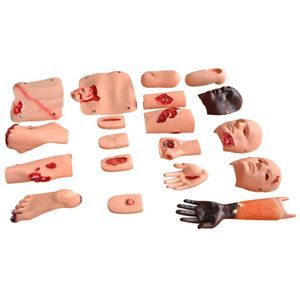
19-module trauma accessory set ADA-401D-1 — burns, lacerations, open fractures, gunshot and amputation wounds for first-aid training.
...
ADA-401D-1: How to Sequence 19 Trauma Modules Into a 90-Minute Class
Short answer: ADA-401D-1 is a 19-module trauma accessory set. The product page publishes three things it is built for — realistic wound appearance and touch, first-aid training of surgical trauma, and simulated bleeding, hemostasis, washing, disinfection and bandaging — plus a numbered module list that runs from facial burns to foot necrosis. It does not publish carton quantity, package size, gross weight or price; all three logistics fields are marked "not available".
Key takeaways
- 19 modules, five mechanisms: burn, laceration, contusion, open fracture and penetrating/necrotic wounds.
- Logistics are unstated. Carton quantity, package size and gross weight all read "not available" — ask before you book freight.
- Order beats coverage. The set rewards a fixed drill sequence far more than free play.
- Moulage and modules are complementary, but published safety guidance on moulage applies to whatever touches the trainee's gloves [1][2].
- Six stations, 15 minutes each is the practical shape of a 90-minute class.
The set at a glance
| Item | Published detail |
|---|---|
| Model | ADA-401D-1 |
| Product name on page | Advanced Trauma Accessories |
| Module count | 19 |
| Stated build | Vivid appearance, "good touch" on all parts |
| Stated training uses | Bleeding, hemostasis, washing, disinfection, bandaging of wounds |
| Quantity per carton | not available |
| Package size | not available |
| Gross weight | not available |
| Price | Not published — quotation required |
Nineteen modules grouped by what they teach
| Mechanism | Modules named on the page | Drill it supports |
|---|---|---|
| Burn | Facial burn I–III; forearm burn I–III | Estimating depth and extent, cooling, non-adherent dressing. |
| Laceration and tear | Forehead laceration; jaw wound; thigh skin tear; parenchyma laceration of the hand | Cleaning, approximation, dressing under tension. |
| Open fracture | Open clavicle fracture with chest contusion; open humerus; open femur; open tibia; open hand fracture with bone exposure | Covering exposed bone, immobilising, controlling ooze. |
| Penetrating | Gunshot wound of the palm; metal pricking wound of the thigh | Entry/exit inspection, packing, tetanus and referral decisions. |
| Amputation and tissue loss | Leg amputation; abdominal wound with protruding intestines | Stump dressing, covering evisceration, positioning. |
| Chronic and infective | Sepsis wound of the thigh; infective ulcer of the thigh; foot necrosis | Recognising non-healing wounds and escalation. |
| Surgical incision | Chest wall section and suture incision; abdomen wall section and suture incision | Closed-wound care and suture-line inspection. |
Why sequence matters more than realism
Wound realism is the part buyers notice first, and the part that matters least on its own. A 2026 trial compared high-fidelity simulation combined with moulage against model-based visual teaching and reported differences in skill outcomes — the conclusion being that the scenario wrapper, not the silicone, drives the result [1]. A global review of moulage safety practice adds the operational side: materials, skin contact and cleaning routines need a written standard before the kit is used on people [2]. A third study used 3D-printed moulage to teach stoma care and measured knowledge and skill gain, again with the training design as the variable [3].
Translated into a classroom: one mechanism per station, a fixed timer, and a verbal handover at the end of each. Nineteen modules are more than enough for six stations, and using eight of them well beats using nineteen once.
A 90-minute class built on six stations
| Station | Modules | Task | Time |
|---|---|---|---|
| 1. Burn assessment | Facial burn I–III, forearm burn I–III | Depth call, cooling, dressing choice, pain plan. | 15 min |
| 2. Open fracture | Open tibia, open femur, open humerus | Cover, align, immobilise, document distal perfusion. | 15 min |
| 3. Evisceration | Abdominal wound with protruding intestines | Moist cover, no re-insertion, positioning, urgent transfer. | 15 min |
| 4. Penetrating hand | Gunshot palm, hand fracture with bone exposure | Assess tendon and nerve function before dressing. | 15 min |
| 5. Amputation | Leg amputation | Stump dressing, pressure, preserve the limb for transfer. | 15 min |
| 6. Chronic wound triage | Sepsis wound, infective ulcer, foot necrosis | Decide: treat, refer or escalate; state the red flags. | 15 min |
Rotate in six groups of two. Each pair writes one line per station: what they saw, what they did, what they would escalate. Collect the six lines — that is your assessment record, and it costs no extra equipment.
What the product page does not publish
| Not stated on the page | Why it matters before ordering |
|---|---|
| Carton quantity, package size, gross weight | All three read "not available"; freight cannot be quoted without them. |
| Module dimensions and attachment method | Decides whether the set fits an existing manikin or needs the 401D body. |
| Skin material and repairability | Moulage paste and repeated cleaning shorten module life. |
| Individual module sales | Replacing one burnt module is cheaper than replacing the set. |
| Price at your quantity | Quotation item; no published band. |
Send those five questions to sophia@adahealthy.com with the model ADA-401D-1 and the station list you plan to run, so the reply can confirm which modules you actually need.
FAQ
Q1. What is ADA-401D-1?
A 19-module trauma accessory set for surgical first-aid training, listed under Trauma (Surgical) Nursing.
Q2. Does it include a manikin body?
The page describes accessories and modules, not a body. Confirm with the supplier whether the set is meant to attach to the ADA-401D full-body simulator or can be used standalone.
Q3. Can the modules simulate bleeding?
The page states the set can be used to simulate bleeding, hemostasis, washing, disinfection and bandaging. It does not publish a bleed-rate control or a fluid reservoir specification.
Q4. What are the shipping dimensions?
They are not published — quantity per carton, package size and gross weight all read "not available". Ask before you request a freight quote.
Q5. Is it suitable for nursing OSCE stations?
Yes, provided your rubric is written around wound assessment, dressing choice and escalation rather than around the number of modules.
Q6. How do I order?
Email sophia@adahealthy.com with model ADA-401D-1, quantity, the modules your curriculum requires and your delivery city.
Request a quotation
Write to sophia@adahealthy.com for the module schedule, packing data and a quotation on ADA-401D-1. Tell us the stations you plan to run; we will map the 19 modules onto them and flag any gaps before you commit.
References
- Comparison of high-fidelity simulation combined with moulage and model-based visual teaching. BMC Nursing. 2026.
- Moulage safety practice around the world: a framework for best practice. Advances in Simulation. 2026.
- The Effect of 3D Printer and Moulage Use on Improving Stoma Care Knowledge and Skills. International Wound Journal. 2026.

Marketing Center
Hong Kong, ChinaProduction Base
Shanghai, ChinaProducts
Contact Us
 Address: Hong Kong, China
 Phone:+86 13383897707
 Email:sophia@adahealthy.com
 Mobile:+86-0379-65160607
举报邮箱:sophia@adahealthy.com
举报电话:+86 19937901373
Social Media