

ADA-401D Trauma Simulator: What 22 Modules Buy You
Article tag: ADA-401D trauma simulator full body trauma manikin trauma moulage training simulator emergency nursi
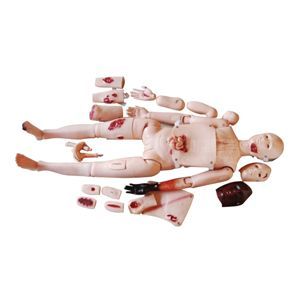
Full-body trauma simulator ADA-401D — 22 wound modules for bleeding, fracture and burn drills; 99 x 42 x 54 cm, 24 kg; price on quotation.
...
ADA-401D Trauma Simulator: What the 22 Modules Actually Buy You
Short answer: ADA-401D is a full-body PVC trauma simulator built around 22 attachable wound modules. The adahealthy product page publishes the carton quantity (1), package size (99 x 42 x 54 cm) and gross weight (24 kg), and names three training categories: washing and disinfection, open fracture and amputation trauma, and a numbered trauma-module set. It does not publish a price, a module-level bill of materials, or a replacement-part list — so it is a quotation item, not a catalogue purchase.
Key takeaways
- 22 modules is a specification, not a curriculum. Ask for the module list in writing; the page shows the first eight entries and then truncates.
- Freight is calculable today: one unit per carton, 99 x 42 x 54 cm, 24 kg gross — enough to price air or sea before you have a quote.
- PVC full-body format means the manikin carries the wound, not the trainee's arm — good for scenario flow, heavier to store.
- Consumables decide lifetime cost, and the page does not list them. That is the first question to send.
- Trauma simulation transfers skills only when scenarios are structured and repeated [1][2][3].
The model at a glance
| Item | Published detail |
|---|---|
| Model | ADA-401D |
| Product name on page | Advanced Trauma Simulator |
| Category path | Nursing Skill Models → Trauma (Surgical) Nursing |
| Body format | Full-body, lifelike PVC manikin |
| Module count | 22 modules (stated on page) |
| Quantity per carton | 1 |
| Package size | 99 x 42 x 54 cm |
| Gross weight | 24 kg |
| Price | Not published — quotation required |
What the three published training categories cover
| Published category | What a trainee can practise | What the page does not claim |
|---|---|---|
| Washing, disinfection, hemostasia, bandaging | Preparing and dressing a wound on a full-body patient, in sequence with movement and handover. | No timed bleed control, no pressure sensor, no fluid-consumption data. |
| Open fracture and amputation trauma | Recognising exposed bone and stump anatomy, then dressing and immobilising. | No stated bone material, no replaceable stump skin. |
| Numbered trauma modules (page shows 1–8 of 22) | Facial burns I–III, forehead laceration, jaw wound, open clavicle fracture with chest contusion, abdominal evisceration, chest and abdominal wall suture incisions, open humerus fracture. | The remaining modules are not listed on the page; ask for the full schedule before comparing suppliers. |
Why the module list matters more than the module count
Two suppliers can both advertise "22 modules" and deliver very different classrooms. The count tells you capacity; the list tells you coverage. On this page the visible entries already span burn, laceration, blunt contusion, open fracture and evisceration — five mechanisms a trauma-nursing OSCE can be built on. What is not visible is whether the set includes gunshot and stab wounds, or a metallic foreign body, which the description text mentions in prose but does not itemise.
The evidence on simulation is consistent about one thing: the manikin is the smaller half of the intervention. A portable, simulation-based trauma curriculum deployed across rural hospitals treated the kit and the curriculum as one package [1]. A qualitative study of UK Defence vascular-access training reported that clinicians describe haemorrhage control as procedural judgement rather than a fixed ABC sequence — which is exactly the judgement a moulage scenario has to force [2]. A systematic review of high-fidelity team-based simulation in acute care reaches the same conclusion at team level: fidelity helps, but debrief structure carries the learning [3].
Landed-cost planning before the quote arrives
| Cost line | What you can fix now | What still needs the supplier |
|---|---|---|
| Freight class | 24 kg gross, carton 99 x 42 x 54 cm, one unit per carton — volumetric weight is roughly 45 kg, so most carriers will charge on volume. | Pallet configuration for multi-unit orders. |
| Duties and taxes | HS classification depends on the importing country; ask your broker to classify the manikin, not the carton. | Country of origin document. |
| Consumables | Not published. | Skin panels, bleed units, wound inserts and their unit prices. |
| Storage | A full-body 24 kg manikin needs a trolley or a designated bay. | Whether a carry bag or hard case is included. |
Send the four lines above to sophia@adahealthy.com with your class size and the modules you must have, and the reply can be a complete landed-cost sheet rather than a unit price.
What the product page does not publish
| Not stated on the page | Why it changes the purchase decision |
|---|---|
| Unit price at your quantity | Education buyers rarely purchase one; the published page gives no volume band. |
| Full 22-module schedule | Decides whether the set matches your national trauma competencies. |
| Replacement parts list | The only reliable way to compare three-year cost of ownership. |
| Skin and module material | Determines whether the surface survives repeated cleaning and moulage paste. |
| Warranty and lead time | Both are procurement gates in public tenders. |
How to run a 45-minute station on it
- Read the scene, do not touch (5 min). Trainees verbalise mechanism of injury from the visible modules before opening any dressing.
- Prioritise (5 min). Rank the wounds; the evisceration and open clavicle compete for the same pair of hands.
- Treat and hand over (20 min). Two rescuers, one narrator, timed. The narrator is what turns a dressing drill into a team drill [3].
- Swap the module set (5 min). Change two modules and re-run the priority call, so trainees learn to re-triage rather than memorise a layout.
- Debrief against the record (10 min). Compare the verbalised priority order with the actual treatment order.
FAQ
Q1. What is ADA-401D?
A full-body PVC trauma simulator from the Trauma (Surgical) Nursing category, built around 22 attachable wound modules.
Q2. What are the shipping figures?
The page publishes one unit per carton, package size 99 x 42 x 54 cm and gross weight 24 kg. Because the carton is large relative to its weight, expect volumetric charging.
Q3. Is a price published?
No. ADA-401D is a quotation item; the page carries no unit price, so any figure you see elsewhere should be confirmed in writing.
Q4. Can it be used for moulage-based exercises?
The manikin is designed to carry simulated wounds rather than applied moulage, but the two are compatible. Published guidance on moulage safety stresses skin-friendly materials and cleaning routines, which is worth matching to the manikin surface [2].
Q5. How many trainees can one unit serve?
The page does not state a class size. Practically, one full-body manikin supports one active team at a time; plan one unit per 8–12 trainees per rotation if you need parallel stations.
Q6. How do I get a quotation?
Email sophia@adahealthy.com with the model number ADA-401D, your quantity, the modules you cannot do without, and your delivery city. Ask for the full module schedule and the consumables list in the same message.
Request a quotation
Write to sophia@adahealthy.com for the ADA-401D specification sheet, the 22-module schedule and a landed-cost quotation. If you are equipping a trauma bay rather than a classroom, say so — the module mix and the trolley specification change with the setting.
References
- Implementing a Portable, Simulation-Based Trauma Curriculum for Rural Hospitals. Journal of Surgical Research. 2026.
- Perceptions of UK Defence vascular access and haemorrhage control training. Trauma Surgery & Acute Care Open. 2026.
- The Role of High-Fidelity Team-Based Simulation in Acute Care Settings: A Systematic Review. Surgery Journal. 2018.

Marketing Center
Hong Kong, ChinaProduction Base
Shanghai, ChinaProducts
Contact Us
 Address: Hong Kong, China
 Phone:+86 13383897707
 Email:sophia@adahealthy.com
 Mobile:+86-0379-65160607
举报邮箱:sophia@adahealthy.com
举报电话:+86 19937901373
Social Media