

BIX-F52: Teaching Cardinal Movements With a 19-Part Fetus
Article tag: BIX-F52 childbirth mechanism model labor mechanism teaching model 19-part fetus model twin delivery
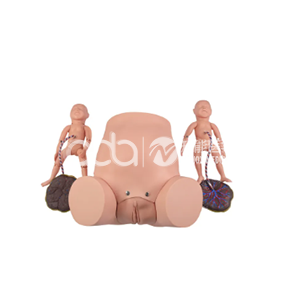
Labor mechanism trainer BIX-F52 — 19-part fetus with fontanelle, twin delivery and abdominal palpation practice for midwifery teaching.
...
BIX-F52: Teaching the Cardinal Movements With a 19-Part Fetus
Short answer: BIX-F52 is a childbirth mechanism teaching model. The page states that the fetus has 19 parts with flexible joints, that the fetal head is soft with a discernible fontanelle, that twin delivery can be demonstrated, and that abdominal palpation and hand delivery are practised on the same set. It ships one unit per carton at 54.5 x 52 x 37 cm and 13 kg.
Key takeaways
- Nineteen parts is the specification that matters: flexible joints are what allow a fetal position to be changed during a demonstration.
- A palpable fontanelle makes the mechanism teachable: students can identify the attitude of the head rather than imagine it.
- Twin delivery is published: two fetuses and two inflatable mats let a session cover a second presentation.
- Hand delivery is part of the set: the two inflatable "mats" between the full-term fetus can be separated for manual delivery practice.
- Logistics are published — 13 kg, 54.5 x 52 x 37 cm — which is more than most cards in this category offer.
What the page publishes
| Item | Published detail |
|---|---|
| Model | BIX-F52 |
| Category | Pediatrics & GYN Models → Labor Mechanisms and Skills Training |
| Fetus | 19 parts, flexible joints, soft head, discernible fontanelle |
| Delivery functions | Standard delivery procedures; twin delivery; abnormal positions |
| Additional practice | Fetal head aspiration, umbilical cord and placenta, abdominal palpation, hand delivery |
| Quantity per carton | 1 |
| Package size | 54.5 x 52 x 37 cm |
| Gross weight | 13 kg |
| Price | Not published — quotation required |
The seven published functions, and the lesson each supports
| Published function | Lesson it supports |
|---|---|
| Demonstrate all standard delivery procedures | A full sequence run-through before students touch a patient. |
| Twin delivery function | Second-presentation handling and the changed mechanics of a twin birth. |
| Prolific presentation simulation | Rapid sequence practice; the page uses this term for a fast, uncomplicated birth. |
| Fetal head aspiration, cord and placenta teaching | Newborn handling immediately after birth. |
| 19-part fetus with flexible joints | Repositioning the fetus to show attitude and presentation. |
| Abdominal palpation model | Leopold manoeuvres and fundal assessment. |
| Hand delivery with two inflatable mats | Manual delivery technique with a separable interface. |
Framing a session around the cardinal movements
The page does not itemise the cardinal movements, but the model's published features map onto them cleanly. Use the sequence below as your lesson plan, and let the 19-part fetus do the demonstrating:
- Engagement and descent (8 min). Set the head at the inlet, then move it down. Ask students what changes at the pelvic floor.
- Flexion (6 min). Show the soft head and fontanelle; flex and extend it so the attitude is visible rather than described.
- Internal rotation (8 min). Rotate the fetus and have students call the position out loud at each step.
- Extension and restitution (8 min). Deliver the head, then show restitution — the step students skip in written answers.
- Twin sequence (10 min). Run the second delivery, including the changed handling after the first birth.
What the evidence says
Obstetric skills are learned by doing, and the evidence is specific about how. A 2026 iScience study found that a preventive trial-and-error model improved breech delivery skills and training transfer in midwifery interns — the mechanism being that learners who are allowed to try and correct retain the skill [1]. A systematic review and meta-analysis of simulation training in obstetric and gynaecological surgery education reported effectiveness and discussed implementation barriers [2]. A 2025 Tunisian study focused on shoulder dystocia simulation and the management of obstetric emergencies [3].
The implication for BIX-F52 is that the model should be used for repeated, correctable attempts — not a single demonstration at the front of the room. The 19-part fetus exists so that a student can be wrong and then fix it.
What the page does not publish
| Not stated | Why it matters |
|---|---|
| Material of the fetus and the pelvis | Determines how the set survives repeated handling. |
| Whether a pelvis or maternal torso is included | The page describes the fetus and functions, not the full maternal component. |
| Optional configurations | The page refers to selecting configurations; the list is not published. |
| Replacement fetus or mats | Consumable cost after loss or damage. |
| Price and lead time | Quotation item. |
Send those five lines to sophia@adahealthy.com with the model number BIX-F52 and your cohort size, and we will answer each one and attach the current supply data.
FAQ
Q1. What is BIX-F52?
An advanced delivery (childbirth) mechanism teaching model with a 19-part fetus, listed under Pediatrics & GYN Models → Labor Mechanisms and Skills Training.
Q2. How many parts does the fetus have?
Nineteen parts with flexible joints, a soft head and a discernible fontanelle, per the product page.
Q3. Does it support twin delivery?
Yes — the page lists a twin delivery function and describes two inflatable mats between the full-term fetus that can be separated.
Q4. Can students practise abdominal palpation on it?
The page includes a pregnant-women abdominal palpation teaching model as part of the set.
Q5. What are the shipping figures?
One unit per carton, package size 54.5 x 52 x 37 cm, gross weight 13 kg.
Q6. How do I get a price?
Email sophia@adahealthy.com with the model (BIX-F52), quantity and the five lines above, and ask for the optional configuration list in the same message.
Request a quotation
Write to sophia@adahealthy.com for the BIX-F52 configuration list and a quotation. If you teach a full midwifery cohort, tell us how many students share one model per session so the number of sets and spare parts is planned with the order.
References
- Preventive trial-and-error model is associated with improved breech delivery skills and training transfer in midwifery interns. iScience. 2026.
- Effectiveness and implementation of simulation training in obstetric and gynecological surgery education: systematic review and meta-analysis. Frontiers in Medicine. 2025.
- Enhancing Obstetric Emergency Management Through Simulation-Based Training: A Focus on Shoulder Dystocia. La Tunisie Medicale. 2025.

Marketing Center
Hong Kong, ChinaProduction Base
Shanghai, ChinaProducts
Contact Us
 Address: Hong Kong, China
 Phone:+86 13383897707
 Email:sophia@adahealthy.com
 Mobile:+86-0379-65160607
举报邮箱:sophia@adahealthy.com
举报电话:+86 19937901373
Social Media