

BIX-DGN30 Review: 99 Signs, One Remote, 11 kg of Kit
Article tag: BIX-DGN30 auscultation simulator cardiopulmonary auscultation model heart sound simulator lung sound
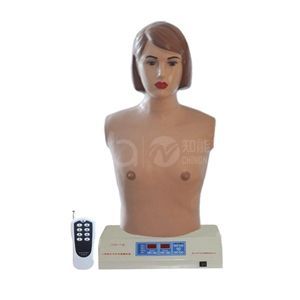
Cardiopulmonary auscultation simulator BIX-DGN30 — 99 heart and lung signs, wireless remote, 11 kg gross for classroom teaching.
...
BIX-DGN30 Review: 99 Signs on One Remote, and the 11 kg That Decides Where It Lives
Short answer: BIX-DGN30 is a wireless, remote-controlled cardiopulmonary auscultation and palpation simulator that the page says reproduces 99 cardiopulmonary signs. It ships one unit per carton at 92 x 47 x 36 cm and 11 kg gross. It is a classroom diagnosis trainer: the teacher calls a sign from the remote or keyboard, the student examines and describes it, and the teacher scores the answer.
Key takeaways
- The number that matters is 99 — that is the sign library the page claims, covering normal and abnormal heart sounds, murmurs, pericardial friction and lung sounds.
- Control is deliberately low-tech: a wireless remote and a keyboard, so a teacher can change signs mid-session without a laptop.
- 11 kg in a 92 x 47 x 36 cm carton is a bench instrument, not something a student carries between rooms.
- The page publishes no price and no speaker or headset specification, which are the two things to settle before a purchase order.
- Auscultation is a trainable skill with measurable gains from simulation, but the gain depends on repeated cued practice, not on the device alone [1][2].
Specification, as published
| Item | Published detail |
|---|---|
| Model | BIX-DGN30 |
| Category | Diagnosis Models → Auscultation of heart and lungs |
| Sign library | 99 cardiopulmonary palpation and auscultation signs |
| Control | Wireless remote control and keyboard entry |
| Audio | Digital voice chip, described as looped without distortion |
| Quantity per carton | 1 |
| Package size | 92 x 47 x 36 cm |
| Gross weight | 11 kg |
| Price | Not published — quotation required |
What the 99 signs cover
| Sign group named on the page | Teaching use |
|---|---|
| Normal heart sounds | The baseline every abnormal sound is compared against. |
| Abnormal heart sounds and cardiovascular murmurs | Timing and grading drills, with the student naming the phase. |
| Pericardial friction and precordial tremor | Palpation and auscultation combined in one examination sequence. |
| Pathological breath sounds, wet and dry rales | Differentiating lung findings that sound similar at low volume. |
| Pleural friction and vocal fremitus | Palpation findings paired with the auscultatory ones. |
How a session actually runs
| Step | What happens | Why the design helps |
|---|---|---|
| 1 | Teacher selects a sign on the remote or keyboard. | No laptop boot-up between cases; the switch is instant. |
| 2 | Student examines and states the location and characteristics. | Forces a verbal description, not a multiple-choice guess. |
| 3 | Teacher reveals and scores. | Turns the device into an assessment station rather than a demo. |
| 4 | Repeat with a contrasting sign. | Contrast is what builds discrimination between similar murmurs and rales. |
What the evidence says
A 2025 study of virtual simulation for cardiac auscultation found measurable improvement in auscultatory skills among post-graduate trainees, which supports simulation as a skill-building method rather than a novelty [1]. A high-fidelity simulation study with nursing students reported gains in both knowledge and auscultation skill [2]. A systematic review of cardiac simulator technologies concluded that the design of the simulator — what it can reproduce and how it is controlled — is itself a determinant of training value [3].
The practical reading: a 99-sign library is useful only if the session is structured around contrast and scoring. If the teacher plays sounds while students listen passively, the library size stops mattering.
Limits you should know before ordering
| Not published or not covered | What to confirm |
|---|---|
| Speaker and headset options | Whether individual headsets are supported, or the class listens from one speaker. |
| List of the 99 signs | Ask for the sign list to check it against your syllabus before you buy. |
| Language of any voice prompts | Matters if the class is taught in English, Russian or Arabic. |
| Power and battery | A bench unit at 11 kg still needs a socket or a charged pack. |
| Price and lead time | Not on the page; this is a quotation item. |
Send those five lines to sophia@adahealthy.com with the model number BIX-DGN30 and your class size, and we will answer each one and attach the current supply data.
FAQ
Q1. What is BIX-DGN30?
A remote computer chest cardiopulmonary auscultation simulator listed under Diagnosis Models, used for heart and lung sound teaching and assessment.
Q2. How many signs does it reproduce?
The product page states 99 kinds of cardiopulmonary palpation and auscultation signs. It does not publish the full list, so request it before mapping the device to a syllabus.
Q3. How is it controlled?
Through a wireless remote control or the keyboard, using a digital voice chip for playback.
Q4. What are the shipping figures?
One unit per carton, package size 92 x 47 x 36 cm, gross weight 11 kg.
Q5. Can students use it without a teacher?
The published workflow is teacher-led: select a sign, let the student examine and describe, then score. Self-study is possible but the page describes an assessment loop.
Q6. How do I get a price?
Email sophia@adahealthy.com with the model (BIX-DGN30), your quantity and the five lines above, and ask for the sign list in the same message.
Request a quotation
Write to sophia@adahealthy.com for the BIX-DGN30 sign list, headset options and a quotation. If you are equipping a physical-diagnosis lab, tell us how many students examine at once so the audio arrangement is specified with the unit.
References
- Teaching Cardiac Auscultation: Effectiveness of Virtual Simulation-Based Training on Improving Cardiac Auscultatory Skills. Cureus. 2025.
- Effectiveness of a high-fidelity simulation in terms of cardiac auscultation knowledge and skills among nursing students. Medicine. 2025.
- Cardiac Simulator Technologies and Design for Medical Education and Auscultation Training: A Systematic Review. Bioengineering. 2025.

Marketing Center
Hong Kong, ChinaProduction Base
Shanghai, ChinaProducts
Contact Us
 Address: Hong Kong, China
 Phone:+86 13383897707
 Email:sophia@adahealthy.com
 Mobile:+86-0379-65160607
举报邮箱:sophia@adahealthy.com
举报电话:+86 19937901373
Social Media