
Tracheostomy Suction on BIX/2700: The 15-Second Pass
Article tag: BIX/2700 tracheostomy suctioning simulator tracheostomy suction training model airway clearance nurs
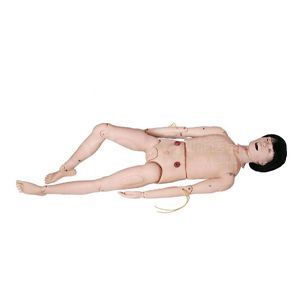
Tracheostomy suctioning trainer BIX/2700 — mock sputum loading, 10-20 cm catheter depth, 15-second passes for airway-clearance practice.
...
Tracheostomy Suction on BIX/2700: How to Run a 15-Second Pass That Trainees Can Repeat
Short answer: BIX/2700 is an adult tracheotomy suctioning and care simulator. Its page publishes a concrete load-and-time protocol: 20–30 ml of mock sputum (5 parts liquid to 2 parts water) into the trachea-bronchial junction, catheter depth 10–20 cm, each pass within 15 seconds, 3–5 minutes between passes. That protocol is what turns the model from a prop into a drill.
Key takeaways
- The page gives a recipe, not just a manikin: 20–30 ml load, 5:2 liquid-to-water mix, 10–20 cm depth, 15-second pass, 3–5 minute interval.
- Order matters on the page: suction the stoma site first, then insert; finish with mouth and nose.
- 15 seconds is the teachable number. It is short enough that trainees rush and long enough that hypoxia risk is real.
- The model also supports a wider care list — bed bath, transfer, axial turning, restraints, pupil observation, ear irrigation, nasal and oral suction.
- Package size is blank on the page, so carton data must be requested before freight is quoted.
The published protocol, step by step
| Step | What the page states | What the instructor should watch |
|---|---|---|
| 1. Load | Inject 20–30 ml of sputum (5 parts liquid to 2 parts water) into the trachea-bronchial junction; diluted dish soap may replace sputum. | Load volume: too little and the pass ends before the technique is tested. |
| 2. Prepare | Connect the suction catheter and moisten it before the attempt. | Whether the trainee wets the catheter or skips it under time pressure. |
| 3. Suction the stoma | Suction the tracheostomy site first. | Cleaning the stoma before going down the airway. |
| 4. Insert | Insert the catheter through the stoma to a depth of 10–20 cm. | Depth judgement — too shallow misses secretions, too deep irritates the carina. |
| 5. Withdraw | Rotate left and right while withdrawing outwards, suctioning secretions. | Rotation and steady withdrawal instead of a straight pull. |
| 6. Finish | Suction the mouth and nose last. | That oral and nasal care is not skipped. |
| 7. Time | Each pass within 15 seconds; 3–5 minutes between passes; repeat as needed. | The clock. This is the step trainees fail. |
What else the same model covers
| Published skill | Use in a care session |
|---|---|
| Bed bath and changing clothes | Dignity-preserving care around a tracheostomy, with the tube kept secure. |
| Moving and transporting a patient | Head-of-bed transfer, wheelchair and stretcher handling with airway equipment attached. |
| Axial turning and restraint methods | Turning a patient without traction on the tube; limb, shoulder and full-body restraint. |
| Pupil observation | Normal versus dilated pupils as part of neurological checks during care. |
| Ear irrigation and nasal suction | Adjacent airway and hygiene skills on the same session. |
| Oral, nasal and endotracheal suction | Suction tube and Yankauer practice through the mouth, nose and trachea. |
Why the 15-second limit is the whole lesson
Suction is a hypoxic intervention disguised as a cleaning task. Every second the catheter is in the airway, ventilation is interrupted. A 2025 study used simulation specifically to evaluate airway-clearance devices, which is the right frame: the device and the pass are the variables you can standardise [1]. A scoping review of nursing care for the "airway clearance" focus shows how often the procedure is documented as a task rather than as a timed intervention [2]. A 2026 comparison of dual-system endotracheal suction went further and measured cardiopulmonary function during suction in ventilated adults — evidence that the pass length and technique are physiological variables, not style preferences [3].
Practically, that means the model should be used with a visible timer from the first attempt. Trainees who are told "15 seconds" and not timed will take 25–30 seconds and believe they were fast.
Station plan for a 45-minute session
- Load and brief (5 min). Prepare 20–30 ml of the 5:2 mix and state the three numbers out loud: 10–20 cm, 15 seconds, 3–5 minutes.
- Observe one clean pass (5 min). Instructor demonstrates while a second trainee times and calls the seconds.
- Timed practice (15 min). Each trainee performs two passes with a partner timing; record the actual duration on the board.
- Oral and nasal finish (10 min). Practise the mouth-and-nose step and the Yankauer route, which is where cross-contamination habits form.
- Debrief with numbers (10 min). Compare each trainee's pass length against 15 seconds, then repeat the worst two attempts.
What the product page does not publish
| Not stated on the page | Why it matters before ordering |
|---|---|
| Package size and carton weight | The package-size field is empty; freight and storage need the carton data. |
| Material of the trachea and stoma | Decides how many suction cycles the airway survives before replacement. |
| Replacement airway or stoma module | Consumable cost per class, and whether a session can be reset in minutes. |
| Whether a suction unit is included | The page describes the manikin's functions, not the vacuum source. |
| Price at your quantity and lead time | Quotation item, not a published-price product. |
Send those five lines to sophia@adahealthy.com with the model number BIX/2700 and your class size, and we will answer each one and attach the current supply data.
FAQ
Q1. What is BIX/2700?
An advanced adult tracheotomy suctioning and care simulation model listed under Nursing Skill Models → Trauma (Surgical) Nursing.
Q2. What do I load into the airway?
The page states 20–30 ml of sputum made from 5 parts liquid to 2 parts water, injected into the trachea-bronchial junction. Diluted dish soap can be used instead of sputum.
Q3. How deep should the catheter go?
10–20 cm through the tracheostomy site, according to the product page.
Q4. How long should each suction pass last?
Within 15 seconds, with a 3–5 minute interval between passes, and the sequence can be repeated.
Q5. Does it include a suction machine?
The page describes the manikin's functions and does not state that a vacuum unit is included. Confirm this in your enquiry if you do not already have a suction source.
Q6. How do I get a price and carton data?
Email sophia@adahealthy.com with the model (BIX/2700), your quantity and the five lines above. Ask for package size and weight in the same message so the quotation is complete.
Request a quotation
Write to sophia@adahealthy.com for the BIX/2700 specification sheet and a quotation. If you are equipping a nursing skills lab, tell us how many stations you plan to run and whether you need replacement airway modules, so the consumable plan is quoted with the model.
References
- Use of simulation in the evaluation of airway clearance devices. Jornal de Pediatria. 2025.
- Nursing Process Related to the Nursing Focus "Airway Clearance": A Scoping Review. Nursing Reports. 2024.
- Effectiveness of Dual-System Endotracheal Suction on Cardiopulmonary Functions in Mechanically Ventilated Adult Patients. Iranian Journal of Nursing and Midwifery Research. 2026.

Marketing Center
Hong Kong, ChinaProduction Base
Shanghai, ChinaProducts
Contact Us
 Address: Hong Kong, China
 Phone:+86 13383897707
 Email:sophia@adahealthy.com
 Mobile:+86-0379-65160607
举报邮箱:sophia@adahealthy.com
举报电话:+86 19937901373
Social Media