

ACLS160 Baby Simulator Review: 7 Skills Tested
Article tag: ACLS160 baby simulator infant first aid training simulator pediatric nursing manikin baby CPR traini
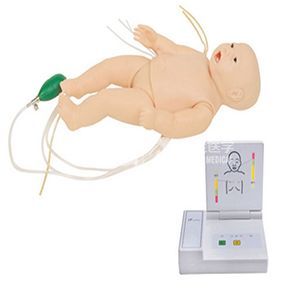
Infant first-aid simulator ACLS160 — intubation, IV/IO, gastric tube, scored CPR and 100+ heart, lung and bowel sounds for pediatric drills.
...
ACLS160 Review: A Seven-Skill Infant Simulator, Judged Against Its Own Spec Sheet
Short answer: ACLS160 is an infant first-aid training simulator that publishes seven capability groups: vital-sign simulation with pupil and pulse comparison, airway management with oral intubation and suction, intravenous puncture, gastric-tube placement confirmed by auscultation, tibial bone-marrow puncture, electronically scored CPR, and cardiopulmonary auscultation with more than 100 sound sources. The page gives no package size, no weight and no price — so this review judges capability, not value for money.
Key takeaways
- Breadth is the selling point: one baby covers airway, vascular access, GI access, IO access and CPR.
- CPR is instrumented. The page claims electronic monitoring of airway opening, breath rate and volume, compression rate, position and depth, with automatic judgement.
- 100+ auscultation sources is a teaching feature, not a gimmick — normal versus abnormal is the hard part of infant assessment.
- Logistics and price are not published. Plan a quotation step before any tender.
- Skills decay without refreshers, and infant resuscitation is high-acuity, low-frequency work [1][2][3].
Capability matrix
| Published capability | Detail on the page | Where it is strong | Where it stops |
|---|---|---|---|
| Vital signs | Bilateral pupils shown dilated versus normal; femoral, brachial and radial pulsation | Neurological and perfusion checks in one look | No published blood-pressure or SpO2 function |
| Airway management | Mouth, nose, tongue, gums, pharynx, larynx, oesophagus, epiglottis, trachea; oral intubation; suction | Anatomy detailed enough for tube-placement drills | No stated confirmation method beyond auscultation |
| Intravenous puncture | Cephalic vein, dorsal hand veins, superior frontal and superficial temporal veins, femoral vein | Scalp-vein practice, which is infant-specific | No published flashback or fluid-return detail |
| Gastric tube | Auscultation used to confirm tube position; decompression, nasal feeding, lavage | Teaches the confirm-by-auscultation habit | No pH or aspirate simulation claimed |
| Bone-marrow puncture | Tibial route with simulated marrow outflow; medication or infusion can be injected | IO access, the infant fallback when IV fails | Single site; no humeral route claimed |
| CPR | Mouth-to-mouth, mouth-to-nose, bag-to-mouth; electronic scoring of airway opening, breath rate and volume, compression rate, position and depth | Objective feedback without an instructor counting | No published guideline-version mapping |
| Auscultation | More than 100 sound sources: normal and abnormal heart sounds, breath sounds, bowel sounds, vascular murmurs | Sound discrimination drills | No published speaker or headset specification |
What the CPR scoring actually changes
Compression feedback converts a subjective drill into a number, and numbers are what make infant CPR practice repeatable. The 2023 International Consensus on CPR and emergency cardiovascular care science continues to treat high-quality compressions as the central modifiable variable [3]. Two 2026 education studies point the same way from the training side: a programme using entrustable professional activities to build paediatric emergency skills reported structured skill progression [2], while a study of physician-supervised medical students delivering infant basic life support examined whether supervised learners can extend access to training at all [1]. Both assume the learner gets objective feedback somewhere in the loop.
Where ACLS160 fits: it supplies that feedback for compressions and ventilations, and it supplies the anatomy for the access skills that surround resuscitation. Where it does not: it cannot tell you whether your team's role allocation is right. That is a scenario design job.
Auscultation sound bank: what 100+ sources buy you
| Sound group | Published coverage | Drill idea |
|---|---|---|
| Heart sounds | Normal and abnormal | Murmur versus normal in a febrile infant; state the referral threshold. |
| Breath sounds | Normal and abnormal | Wheeze versus stridor versus crackles; match to the airway anatomy already on the manikin. |
| Bowel sounds | Included | Post-gastric-tube check: confirm placement and describe what you hear. |
| Vascular murmurs | Included | Differentiate from transmitted breath sounds before escalating. |
Cost of ownership: the questions the page leaves open
| Not published | Why it decides the purchase |
|---|---|
| Price at your quantity | No published band; budget approval needs a written quote. |
| Package size and weight | The specification table leaves the package field empty — freight cannot be estimated. |
| Consumables | IV and IO pads, airway lubricant, vein skins: these recur annually. |
| Software and firmware updates | Scored CPR implies firmware; ask how updates are delivered. |
| Warranty and service | Electronics fail; the repair route matters more than the purchase price. |
Ask sophia@adahealthy.com for the price, the packed dimensions and the consumable list in one message, quoting model ACLS160, so the three answers arrive together.
Who should buy it, and who should not
Buy it if you run paediatric nursing, paediatric emergency or pre-hospital infant training, and you want one manikin that carries the whole sequence from airway to access to compressions. The seven capability groups overlap with what an infant assessment station needs, and the scored CPR removes the instructor from the counting loop.
Do not buy it as a standalone resuscitation solution for a team course. It is a skills manikin; team behaviour, communication and role allocation need a scenario framework around it. Nor is it a substitute for a high-fidelity neonate if your curriculum depends on respiratory physiology that the page does not describe.
FAQ
Q1. What is ACLS160?
An infant ("baby") comprehensive first-aid training simulator covering vital signs, airway, IV access, gastric tube, tibial IO, CPR and auscultation.
Q2. Does it score CPR performance?
Yes. The page states electronic monitoring of airway opening, breath rate and volume, compression rate, position and depth, with automatic judgement.
Q3. Which vascular access sites are available?
Cephalic vein, dorsal hand veins, superior frontal and superficial temporal veins, and the femoral vein, plus tibial bone-marrow puncture.
Q4. How many auscultation sounds?
More than 100 sources, spanning normal and abnormal heart sounds, breath sounds, bowel sounds and vascular murmurs.
Q5. Is a price or package size published?
No. The page publishes no price and leaves the package-size field empty; both need a quotation request.
Q6. How do I request a quotation?
Email sophia@adahealthy.com with model ACLS160, quantity, and the skills your curriculum must cover.
Request a quotation
Write to sophia@adahealthy.com for the ACLS160 specification sheet, packed dimensions and a quotation. If you also run adult emergency training, say so — the same catalogue carries adult and child simulators, and specifying them together usually simplifies the tender.
References
- Can physician-supervised medical students expand access to infant basic life support training?. Resuscitation Plus. 2026.
- Enhancing Pediatric Emergency Medicine Skills Through Entrustable Professional Activities. Cureus. 2026.
- 2023 International Consensus on Cardiopulmonary Resuscitation and Emergency Cardiovascular Care Science With Treatment Recommendations. Circulation. 2023.

Marketing Center
Hong Kong, ChinaProduction Base
Shanghai, ChinaProducts
Contact Us
 Address: Hong Kong, China
 Phone:+86 13383897707
 Email:sophia@adahealthy.com
 Mobile:+86-0379-65160607
举报邮箱:sophia@adahealthy.com
举报电话:+86 19937901373
Social Media