

BIX-Z1000-GF Auscultation System: Honest Review
Article tag: BIX-Z1000-GF auscultation system cardiopulmonary auscultation simulator multi-stethoscope training s
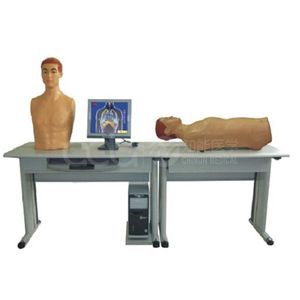
Cardiopulmonary teaching system BIX-Z1000-GF — real stethoscopes, multiple listeners at once, 350+ signs, plus abdominal examination modules.
...
BIX-Z1000-GF Cardiopulmonary Auscultation System: An Honest Review
Short answer: BIX-Z1000-GF is the teacher's master unit in a cardiopulmonary and abdominal examination training system. Its defining feature is not the sound library — it is that several students can listen at different sites at the same time with ordinary stethoscopes. The page claims more than 350 training items, twelve palpation features and seven combined valvular diseases. That combination is what a clinical skills lab should evaluate, because it changes how a group of twelve is taught, not just what they hear.
Key takeaways
- Multi-listener design: several stethoscopes can auscultate different sites simultaneously, which removes the "one listens, the rest watch" bottleneck.
- Real stethoscopes: the page states that an ordinary stethoscope is used, so trainees practise the instrument they will carry.
- Breadth is the selling point: over 350 items, twelve palpation features, and seven combined valvular scenarios.
- Abdominal module is named but not specified: the page ends with "Abdominal Examination Teaching System" and gives no detail.
- Package size and weight are "not available" — confirm before quoting freight.
The system at a glance
| Item | Published detail |
|---|---|
| Model | BIX-Z1000-GF (teacher master unit) |
| Category | Diagnosis Models → Auscultation of heart and lungs |
| Simulated patient | High-polymer skin, tensile strength ≥2 MPa, tear-resistant, realistic texture |
| Lung sounds | Normal and abnormal breath sounds, dry/wet rales, pleural friction rub, at matching sites |
| Cardiac sounds | All valve areas plus clinical extra sites (e.g. mitral opening snap medial to the apex) |
| Palpation | Twelve cardiopulmonary palpation features, including thrills, friction rubs and tactile fremitus |
| Content volume | Over 350 training items; seven combined valvular disease scenarios |
| Listening | Multiple users, multiple stethoscopes, different sites, simultaneously |
| Package size / weight | Not available |
| Price | Not published — quotation required |
What actually improves in the classroom
The usual auscultation lesson runs one of two ways. Either the teacher demonstrates on a single electronic stethoscope while students queue, or the class listens to a recording and nobody agrees on where the sound was loudest. The multi-stethoscope design removes both failures: six students can stand around one patient, each listening at a different intercostal space, and then swap.
That matters because auscultation is a localisation skill before it is a diagnosis skill. A student who cannot say where a murmur is loudest cannot use the finding. The page's cardiac detail — naming the mitral opening snap medial to the apex, pericardial knock and ventricular septal defect at the fourth left intercostal space, left ventricular hypertrophy lateral to the midclavicular line — is a teaching map, not marketing copy.
Feature-to-benefit table
| Published feature | Benefit for a skills lab |
|---|---|
| Ordinary stethoscope compatibility | Trainees use their own instrument; no proprietary headset to learn. |
| Simultaneous multi-site listening | One patient serves a group of six to eight without rotation queues. |
| Over 350 items | Covers undergraduate syllabus plus advanced signs, so the unit does not expire after year one. |
| Twelve palpation features | Links what the hand feels to what the stethoscope hears — the pairing examiners test. |
| Seven combined valvular diseases | Teaches mixed lesions, which is where students usually default to a single-valve answer. |
| High-polymer skin | Repeated cleaning and handling without surface cracking (cleaner to be confirmed). |
What to test in a live demo
- Listener count. Bring six stethoscopes and six students. Confirm all six hear the assigned site clearly, not just the first two.
- Site separation. Ask for mitral stenosis and aortic insufficiency at adjacent areas. If the sounds bleed into each other, group teaching collapses.
- Volume and clarity. Test at the quietest setting your lab will realistically have — not in a silent showroom.
- Scenario switching. Time how long it takes to change from a normal chest to a combined valvular case. Long menus cost teaching minutes.
- Abdominal module. The page names an abdominal examination teaching system but gives no specification. Ask for the module list before you assume it is included.
- Service and updates. Ask how the sound library is updated and whether the master unit can drive additional student manikins later.
What the evidence says about auscultation simulation
A 2026 practical review of cardiac auscultation argues that the technique is being de-skilled by imaging and that deliberate repetition is the remedy [1]. A high-fidelity simulation study in nursing students found measurable gains in both knowledge and skill compared with conventional teaching [2]. A systematic review of cardiac simulator technologies concluded that fidelity alone does not predict learning — the debrief and the scenario design do [3]. Read together, the evidence supports a system that lets a whole group listen at once, because it increases repetitions per session; it does not support buying the largest sound library and hoping for the best.
What the product page does not publish
| Not stated on the page | Question to ask |
|---|---|
| Maximum number of simultaneous stethoscopes | Six? Ten? This decides group size and station layout. |
| Abdominal module contents | Which signs, and whether the module is included or optional. |
| Power and control hardware | Is the master unit a PC, a tablet or a dedicated console? |
| Package size and weight | Printed as "not available"; needed for freight and lab planning. |
| Price, warranty, training | Quotation item — request all three together. |
Send those questions to sophia@adahealthy.com with the model number BIX-Z1000-GF and your cohort size, and we will answer each one before you schedule a demo.
FAQ
Q1. What is BIX-Z1000-GF?
The teacher's master unit of an intelligent cardiopulmonary and abdominal examination training system, used for auscultation and palpation teaching.
Q2. Do students need special headphones?
No. The page states that an ordinary stethoscope can be used, and that multiple users can listen at different sites at the same time.
Q3. How many signs are included?
The page states that total skills training content exceeds 350 items, including normal and abnormal breath sounds, cardiac murmurs and twelve palpation features.
Q4. Does it cover combined valve disease?
Yes. The page lists seven types of multi-valvular heart disease, such as mitral stenosis with aortic insufficiency.
Q5. Is the abdominal examination module included?
The page names an abdominal examination teaching system but does not specify its contents or whether it is part of this unit. Confirm before ordering.
Q6. How do I get a price?
Email sophia@adahealthy.com with the model (BIX-Z1000-GF), the number of students per station and your city, and ask for the abdominal module list and carton data in the same message.
Request a quotation
Write to sophia@adahealthy.com for the BIX-Z1000-GF specification sheet and a quotation. If you are equipping several stations, ask in the same email how one master unit can drive additional student manikins, so the lab can grow without buying a second teacher console.
References
- Cardiac Auscultation: A Practical Review of Technique, Modern Tools and Strategies to Maintain Diagnostic Skill. Cardiology in Review. 2026.
- Effectiveness of a High-Fidelity Simulation in Terms of Cardiac Auscultation Knowledge and Skills. Medicine (Baltimore). 2025.
- Cardiac Simulator Technologies and Design for Medical Education and Auscultation Training: A Systematic Review. Bioengineering (Basel). 2025.

Marketing Center
Hong Kong, ChinaProduction Base
Shanghai, ChinaProducts
Contact Us
 Address: Hong Kong, China
 Phone:+86 13383897707
 Email:sophia@adahealthy.com
 Mobile:+86-0379-65160607
举报邮箱:sophia@adahealthy.com
举报电话:+86 19937901373
Social Media