

BIX-S20 Hemorrhage Control Arm: 4-Wound Station Guide
Article tag: BIX-S20 hemorrhage control arm hemorrhage control trainer wound packing model tourniquet training ar
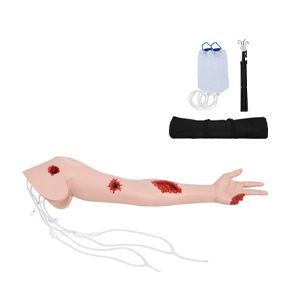
Hemorrhage control arm BIX-S20 — four wounds, skin-like silicone, built-in perfusion line, for packing, pressure dressing and tourniquet drills.
...
BIX-S20 Hemorrhage Control Arm: How to Build a Four-Wound Station
Short answer: BIX-S20 is a silicone arm trainer with four traumatic wounds: a through-and-through gunshot wound at the shoulder, an entry gunshot wound on the upper arm, a forearm laceration and a fingertip crush laceration. It supports active bleeding through a built-in perfusion line, and it is designed for wound packing, compression bandaging and tourniquet application. It is an arm trainer, so junctional and truncal bleeding are outside its scope.
Key takeaways
- Four wounds, four different decisions. The shoulder, upper arm, forearm and fingertip wounds do not all call for the same technique.
- Skin-like silicone supports repeated packing, compression and tourniquet practice.
- A built-in perfusion line allows dynamic bleeding, so the trainee sees the effect of pressure, not just the anatomy.
- The page lists four course uses: battlefield emergency hemostasis, wound packing, auxiliary venous puncture and traumatic wound dressing.
- Package size, weight and price are not published; confirm all three before ordering.
The four wounds
| Wound | Location | Teaching focus |
|---|---|---|
| Through-and-through gunshot wound | Shoulder | Entry and exit assessment; packing a tract that passes through tissue. |
| Entry gunshot wound | Upper arm | Direct pressure and packing where a tourniquet may be proximal. |
| Laceration | Forearm | Compression dressing and wound packing on a long, shallow wound. |
| Crush laceration | Fingertip | Difficult dressing geometry; pressure without compromising the rest of the hand. |
A four-station drill
- Station 1 — assess and expose. Gloves, direct pressure, and a decision about whether the wound is compressible or requires packing. Do not let the trainee start with gauze before they have looked at the wound.
- Station 2 — pack the tract. Use the shoulder through-and-through wound. The trainee must pack from the deepest point outward, not just cover the entry.
- Station 3 — compress and bandage. Use the forearm laceration. The endpoint is a dressing that holds pressure without cutting off distal circulation.
- Station 4 — tourniquet. Use the upper arm wound. The trainee applies the tourniquet proximally, tightens until bleeding stops, and records the time. Then reassess.
The fingertip wound is a useful fifth micro-station: it forces the trainee to solve a dressing problem where a standard bandage does not fit. Keep it short and assess technique, not speed.
What the perfusion line changes
A static wound model teaches packing mechanics. A perfused model teaches the feedback loop: pressure changes the flow, and the trainee can see whether the bleeding stops. The page states that the built-in pipeline is compatible with simulated blood perfusion, so the instructor can run the drill as a cause-and-effect exercise rather than a demonstration.
The limitation is that simulated blood is not blood. Viscosity, clotting and contamination are not reproduced. The model teaches the mechanical steps and the decision sequence; it does not teach haemostasis or infection control.
What the evidence says about hemorrhage control training
A study of extremity and junctional tourniquet training among medical interns examined effectiveness and retention [1]. A pilot study implemented a Stop the Bleed course with prelicensure nursing students [2]. A 2026 review asked whether tourniquets for extremity injuries save lives [3]. The practical takeaway for a skills lab is that retention depends on repetition and reassessment, not on a single certification day.
This is also the honest limitation of BIX-S20: it is an arm. It does not simulate a junctional wound, a pelvic binder, a chest seal or a truncal injury. If your course covers those, the arm is one station in a larger set.
What the page does not publish
| Not stated | Why it matters |
|---|---|
| Quantity per carton, package size, gross weight | All three are printed "not available"; freight and storage need the numbers. |
| Replacement skin or wound modules | The silicone wounds are the wear items; a multi-year plan needs part numbers. |
| Simulated blood supply and consumable volume | The perfusion line needs a fluid source; confirm what is included. |
| Price and lead time | This is a quotation item. |
Send those four lines to sophia@adahealthy.com with the model number BIX-S20 and your annual class size, and we will answer each one and attach the current supply data.
FAQ
Q1. How many wounds does BIX-S20 have?
Four: a through-and-through gunshot wound at the shoulder, an entry gunshot wound on the upper arm, a forearm laceration and a fingertip crush laceration.
Q2. Does it bleed?
The page states a built-in pipeline compatible with simulated blood perfusion for dynamic wound bleeding.
Q3. What techniques can be practised?
Wound packing, compression bandaging and tourniquet application, plus traumatic wound dressing and auxiliary venous puncture as listed on the page.
Q4. What is it made from?
Medical-grade simulated silicone with a texture close to human skin, according to the page.
Q5. Does it cover junctional or truncal bleeding?
No. It is an arm trainer; junctional, pelvic and truncal wounds are outside its scope.
Q6. How do I get a price?
Price is not published. Email sophia@adahealthy.com with the model (BIX-S20) and your quantity, and ask for the carton data and the replacement-wound list in the same message.
Request a quotation
Write to sophia@adahealthy.com for the BIX-S20 specification sheet and a quotation. If you are building a full bleeding-control station, mention the other trainers you need so the set covers arm, junctional and truncal skills without duplicating the same wound pattern.
References
- Effectiveness and retention of extremity and junctional tourniquet training among medical interns. BMC Medical Education. 2026.
- Implementing a Stop the Bleed Course and Active Shooter Principles With Prelicensure Nursing Students: A Pilot Study. Dimensions of Critical Care Nursing. 2026.
- Do tourniquets for extremity injuries save lives? Trauma Surgery & Acute Care Open. 2026.

Marketing Center
Hong Kong, ChinaProduction Base
Shanghai, ChinaProducts
Contact Us
 Address: Hong Kong, China
 Phone:+86 13383897707
 Email:sophia@adahealthy.com
 Mobile:+86-0379-65160607
举报邮箱:sophia@adahealthy.com
举报电话:+86 19937901373
Social Media