

Z/10BX vs Z/10B: Abdominal Palpation Simulator Choice
Article tag: Z/10BX vs Z/10B abdominal palpation simulator abdominal auscultation trainer blood pressure arm phys
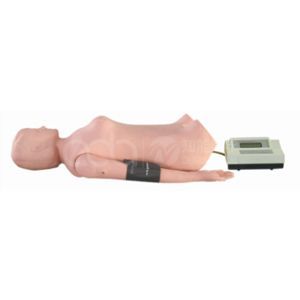
Abdominal simulator BIX-Z/10BX — automated sign selection, LCD readout, liver 0–7 cm, spleen 0–9 cm, breathing-linked organ movement and a BP arm.
...
Z/10BX vs Z/10B: Which Abdominal Palpation Simulator Fits Your Course?
Short answer: BIX-Z/10BX and BIX-Z/10B share the same core abdominal simulator: automatic sign selection, an LCD readout, a life-size soft abdomen and breathing-linked liver and spleen movement. The practical difference is what each version documents. Z/10BX adds a blood pressure arm. Z/10B documents a wider abdominal auscultation set and an assessment function. Buy the version that matches the skills your course actually examines.
Key takeaways
- Same platform, different emphasis. Both use microcomputer control and a fully automated sign-selection system.
- Z/10BX is the version with a BP arm, so it supports combined abdominal and blood-pressure practice in one station.
- Z/10B explicitly lists bowel sounds and assessment: normal, hyperactive and abdominal vascular murmurs, plus an assessment function.
- Carton data is almost identical: 1 unit per carton, 99×44×32 cm; 16 kg for Z/10BX and 17 kg for Z/10B.
- Price is not published for either model — both are quotation items.
Side-by-side, using only what each page publishes
| Feature | BIX-Z/10BX | BIX-Z/10B |
|---|---|---|
| Core control | Microcomputer simulation; fully automatic sign selection | Microcomputer simulation; fully automatic sign selection |
| Display | LCD shows the selected abdominal signs | LCD shows the selected abdominal signs |
| Liver / spleen size | Liver enlarged 0–7 cm; spleen enlarged 0–9 cm | Size can be selectively controlled; ranges not stated |
| Breathing-linked movement | Liver and spleen move up and down with abdominal breathing | Liver and spleen move up and down with abdominal breathing |
| Tenderness responses | Pain sound on tenderness; breath-holding with gallbladder tenderness; appendix tenderness reflected | Pain sound; gallbladder breath-hold; appendix rebound pain; upper abdominal, umbilical, ureteral and lower abdominal points listed |
| Abdominal auscultation | Named in the product title; specific bowel sounds not listed | Normal, hyperactive bowel sounds and abdominal vascular murmurs listed |
| Assessment function | Not stated on the page | Yes — assessment function stated |
| Blood pressure arm | Included (title and page description) | Not stated |
| Carton | 1 pc; 99×44×32 cm; 16 kg gross | 1 pc; 99×44×32 cm; 17 kg gross |
| Price | Not published | Not published |
The table is deliberately limited to published text. Where a page is silent, the correct move is not to assume parity — it is to ask the supplier to confirm in writing.
Choose Z/10BX when the station is a combined physical-examination room
Z/10BX makes sense if your objective is a single encounter that moves from abdominal palpation to blood pressure measurement. The BP arm adds a second skill without a second manikin, and the shared carton size means the room does not need a different bench or storage footprint. The documented liver (0–7 cm) and spleen (0–9 cm) ranges also give instructors a concrete way to build graded cases rather than a single “enlarged organ” demonstration.
Choose Z/10B when abdominal auscultation and assessment are the learning outcomes
Z/10B is the better fit if the course assesses bowel sounds, vascular murmurs or a structured abdominal examination. Its page explicitly lists normal and hyperactive bowel sounds and abdominal vascular murmurs, and it states an assessment function. It also lists a wider set of tender points, including upper abdominal, umbilical, upper and middle ureteral, left upper abdominal and lower abdominal tenderness. If those are the stations your exam blueprint uses, the extra BP arm on Z/10BX does not compensate for the missing documentation.
Three questions that decide it
- Does the exam include blood pressure? If yes, Z/10BX. If no, the BP arm is capital you do not need.
- Does the exam include bowel sounds or vascular murmurs? If yes, confirm the Z/10BX sound set in writing before choosing it; Z/10B already lists them.
- Do you need scoring? Z/10B states an assessment function; Z/10BX does not. If assessment is required, ask for a demonstration or a written confirmation.
What the evidence says about simulator-based examination training
A mixed-methods pilot of a haptic cardiac simulator evaluated the device with medical students and educators, which is the right first question for any physical-examination trainer: does it feel and behave plausibly enough to change learning [1]. A high-fidelity simulation study examined cardiac auscultation knowledge and skills among nursing students [2], and a physiology teaching report describes first experience with a cardiovascular simulator in the classroom [3]. The common thread is not the brand of manikin; it is whether the simulator is tied to a defined skill, a practice schedule and an assessment.
The limitation is equally clear: an abdominal simulator cannot reproduce every cause of an acute abdomen, and neither Z/10BX nor Z/10B is a whole-body patient simulator. They are examination trainers. Use them to standardise technique and interpretation, then transfer to supervised clinical practice.
What to request before a purchase order
| Item | Why it matters |
|---|---|
| Written confirmation of the sound set on Z/10BX | The page names auscultation but does not list bowel sounds or murmurs. |
| Assessment-function confirmation | Z/10B states it; Z/10BX does not. If scoring is required, get it in writing. |
| Price at your quantity and lead time | Neither model publishes a price. |
| Spare parts and service path | The abdomen and electronic components are the long-term cost, not the carton. |
Send the four lines to sophia@adahealthy.com with the model you are leaning toward and your course outline. We will answer each point and, where a page is silent, confirm the specification rather than let you infer it.
FAQ
Q1. What is the main difference between Z/10BX and Z/10B?
Z/10BX includes a blood pressure arm. Z/10B is the stand-alone abdominal version and its page documents abdominal auscultation sounds and an assessment function.
Q2. Do both models simulate liver and spleen enlargement?
Yes. Both pages state that liver and spleen size can be controlled, and that the organs move with abdominal breathing. Z/10BX gives ranges of 0–7 cm for the liver and 0–9 cm for the spleen.
Q3. Which model is better for teaching bowel sounds?
On the published text, Z/10B is more explicit: it lists normal, hyperactive bowel sounds and abdominal vascular murmurs. Ask for written confirmation of the Z/10BX sound set if that is your priority.
Q4. Is the carton size the same?
Yes — both pages state 1 unit per carton and 99×44×32 cm. Gross weight is 16 kg for Z/10BX and 17 kg for Z/10B.
Q5. Can I get a price from the website?
No. Neither page publishes a price; both route to a quotation.
Q6. How do I choose between them?
Start from the exam blueprint: blood pressure, bowel sounds, or scoring. Email sophia@adahealthy.com with those three answers and we will recommend the version that matches, not the one with the longer feature list.
Request a comparison quotation
Write to sophia@adahealthy.com for a side-by-side quotation on BIX-Z/10BX and BIX-Z/10B. Include your course outline, the number of stations and the city of delivery; we will confirm the sound set, the assessment function and the carton data in the same reply.
References
- A Novel Haptic Cardiac Simulator: Mixed Methods Pilot Evaluation in Medical Students and Educators. JMIR Formative Research. 2026.
- Effectiveness of a high-fidelity simulation in terms of cardiac auscultation knowledge and skills among nursing students. Medicine. 2025.
- First Experience With Using a Simulator in Teaching Physiology of the Cardiovascular System. Physiological Research. 2026.

Marketing Center
Hong Kong, ChinaProduction Base
Shanghai, ChinaProducts
Contact Us
 Address: Hong Kong, China
 Phone:+86 13383897707
 Email:sophia@adahealthy.com
 Mobile:+86-0379-65160607
举报邮箱:sophia@adahealthy.com
举报电话:+86 19937901373
Social Media