

BIX/ACLS170B Child First Aid Simulator: Buyer's Checklist
Article tag: BIX/ACLS170B children's first aid training simulator one-year-old paediatric simulator infant first
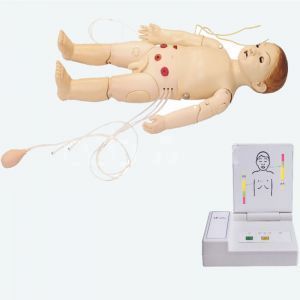
Children's comprehensive first aid simulator BIX/ACLS170B (one-year-old) — intubation, IV access, bone marrow puncture and electronically scored CPR.
...
Buying a One-Year-Old First Aid Simulator: What BIX/ACLS170B Actually Covers
Short answer: BIX/ACLS170B is a one-year-old paediatric patient simulator built for comprehensive first aid training. The published function list covers four procedure families — airway management, vascular access, bone marrow puncture and catheterisation — plus CPR with electronic scoring of ventilation and compression. It belongs in a nursing school, paediatric ward training room or emergency department skills lab where the same body is used across several procedures rather than one.
Key takeaways
- One torso, many procedures. Airway, IV/IO-adjacent access routes, bone marrow puncture, gastric tube, urinary catheterisation and CPR are all listed on a single unit.
- Feedback is electronic for CPR, mechanical for the rest. The page specifies electronic monitoring of airway opening, insufflation frequency and volume, compression frequency, position and depth.
- The listed access sites are specific and can be checked against your curriculum before purchase, not after delivery.
- Package size is blank on the page and price is not published — both must come back in writing.
- This is a paediatric one-year-old body. It does not substitute for a newborn or an adult trainer; plan it as one unit in a set.
Step 1 — match the procedure list to your curriculum
Procurement for a simulator should start from the procedures you are obliged to teach, not from the feature list. The table below restates the supplier's published functions so you can tick them against your syllabus line by line.
| Procedure family | Published capability |
|---|---|
| Vital signs simulation | Visual comparison of bilateral dilated pupils against normal; femoral artery pulsation. |
| Airway management | Realistic mouth, nose, tongue, gums, pharynx, larynx, esophagus, epiglottis and trachea; oral tracheal intubation and sputum suction. |
| Intravenous infusion / puncture | Arm vein, femoral vein and dorsal foot vein. |
| Intramuscular injection | Bilateral deltoid muscle and bilateral lateral femoral muscle. |
| Subcutaneous injection | Subcutaneous tissue on the outside of the thigh. |
| Bone marrow puncture | Tibial puncture with visible surface landmarks and simulated bone marrow outflow. |
| Gastric tube / lavage | Gastric lavage and gastrointestinal decompression; abdominal auscultation to check tube position; gastric juice aspirated after successful intubation. |
| Urinary catheterisation | Replaceable male/female perineum; catheterisation feasible for both. |
| Fistula care | Colon, rectum and bladder fistula care. |
| CPR | Mouth-to-mouth, mouth-to-nose and simple respirator-to-mouth; electronic scoring of airway opening, insufflation frequency and volume, compression frequency, position and depth. |
Step 2 — decide which procedures must give feedback
Not every listed procedure reports back. This is the single most useful distinction in the specification, and it is worth putting into the purchase file.
| Procedure | Feedback stated on the page |
|---|---|
| CPR ventilation and compressions | Electronic: frequency, volume, position, depth; automatic ratio judgement. |
| Bone marrow puncture | Mechanical: visible surface signs plus simulated marrow outflow. |
| Gastric tube placement | Indirect: abdominal auscultation and aspirated gastric juice confirm position. |
| Intubation, IV puncture, injections, catheterisation | Physical realism only; the page does not state electronic scoring. |
If your assessment model depends on scored CPR, this unit fits. If you also need scored airway or vascular access, that has to be confirmed with the supplier — it is not claimed on the page.
Step 3 — the questions to put in writing before you sign
| Question to the supplier | Why it changes the decision |
|---|---|
| Carton dimensions and gross weight | The page's "Package size" field is blank; freight and storage cannot be costed without it. |
| Price at your student number, and lead time | Not published; this is a quotation item. |
| Which functions are standard and which are optional accessories | Several entries on the page are marked as requiring optional attachments; a fair comparison must be like-for-like. |
| Consumable list and unit prices | Veins, skin, perineum inserts and marrow outflow are wear items. |
| Interface language and data export of the CPR scoring | Determines whether scores can be filed as student assessment evidence. |
| Cleaning and disinfection instructions | Shared anatomy and fluid pathways drive the between-cohort routine. |
Send these six lines to sophia@adahealthy.com with the model number BIX/ACLS170B and your cohort size; we will answer each one and attach the current supply data.
Step 4 — what the evidence says about simulator-based paediatric training
Simulator-based training for infant and child resuscitation is well studied. A 2026 study of simulation in undergraduate neonatal resuscitation training reports measurable learning effects from the simulation route [1], and a systematic review of training programmes aimed at team performance in neonatal resuscitation examines which programme designs actually change team behaviour [2]. A separate 2026 paper describes an ultra-low-cost infant CPR manikin built specifically to widen access to training [3].
The practical reading of that literature for a buyer is not "simulation works" — it is that programme design and repetition drive outcomes, and repetition is limited by how many procedures a single unit can sustain. That is the real argument for a multi-procedure paediatric body like ACLS170B over a single-purpose infant CPR manikin: it is not a better manikin, it is more curriculum per square metre of skills lab.
Total-cost view
| Cost line | Why it belongs in the comparison |
|---|---|
| Unit price at your quantity | Not published; request in writing. |
| Optional accessories marked on the page | Turning optional items into like-for-like quotes changes the ranking. |
| Replacement veins, skin and perineum inserts | The wear items across your annual student intake. |
| CPR scoring consumables or software, if any | Confirm whether data export carries a licence. |
| Freight and storage | Depends on the carton data the page does not print. |
FAQ
Q1. What age does BIX/ACLS170B represent?
One year old, per the product page. It is a paediatric body, not a newborn and not an adult trainer.
Q2. Does it score CPR performance?
Yes. The page states electronic monitoring of airway opening, insufflation frequency and volume, compression frequency, position and depth, with automatic ratio judgement.
Q3. Which access routes are provided?
Arm vein, femoral vein and dorsal foot vein for IV puncture; bilateral deltoid and lateral femoral muscle for intramuscular injection; and a tibial site for bone marrow puncture.
Q4. Can male and female catheterisation both be practised?
Yes — the page states the male/female perineum is replaceable and that catheterisation is feasible for both.
Q5. Is the package size published?
No. The "Package size" field on the product page is empty, so carton dimensions and gross weight must be requested.
Q6. How do I get pricing and a like-for-like quote?
Email sophia@adahealthy.com with the model (BIX/ACLS170B) and your cohort size, and ask for the unit price, the optional-accessory status of each function, and the consumable list in the same message.
Request a quotation
Write to sophia@adahealthy.com for the BIX/ACLS170B specification sheet and a quotation. If you are building a paediatric skills room, ask in the same enquiry about the matching newborn and adult units so the anatomical conventions, consumables and scoring software stay consistent across the set.
References
- The effectiveness of using simulation in undergraduate medical students' training in neonatal resuscitation. Sudanese Journal of Paediatrics. 2026.
- Improving team performance in neonatal resuscitation: a systematic review of training programs. Maternal Health, Neonatology and Perinatology. 2026.
- DIY LoCo-Baby: a ultra-low-cost infant CPR manikin for universal training access. Resuscitation Plus. 2026.

Marketing Center
Hong Kong, ChinaProduction Base
Shanghai, ChinaProducts
Contact Us
 Address: Hong Kong, China
 Phone:+86 13383897707
 Email:sophia@adahealthy.com
 Mobile:+86-0379-65160607
举报邮箱:sophia@adahealthy.com
举报电话:+86 19937901373
Social Media