

BIX-ACLS8000 Review: What the ALS Simulator Really Does
Article tag: BIX-ACLS8000 comprehensive first aid simulator ALS training simulator advanced life support manikin
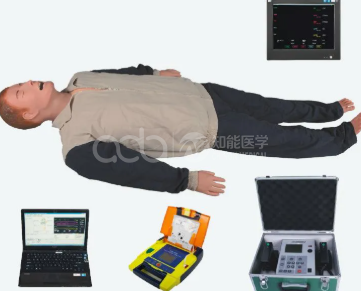
Comprehensive first aid simulator BIX-ACLS8000 — vital-sign pupils, five breathing patterns, airway management and electronic CPR metrics.
...
BIX-ACLS8000 Review: What the Comprehensive First Aid Simulator Actually Does
Short answer: BIX-ACLS8000 is an Advanced Life Support training system rather than a CPR manikin. The published function list covers three areas at once — a head and neck section with adjustable pupils, carotid pulse and patient sounds; a set of five programmable breathing patterns; and airway management from oral and nasal intubation to tracheotomy. On the chest and abdomen it performs electronic monitoring of CPR: number and frequency of ventilations, and number, frequency, position and depth of compressions, with an automatic check of the ventilation-to-compression ratio. Price and package data are not published.
Key takeaways
- It measures technique, not just allows it. Ventilation and compression parameters are electronically monitored and displayed in real time.
- Airway management is a first-class function — oral and nasal intubation, tracheotomy, head-tilt/chin-lift and jaw-thrust are all listed as supported.
- Pupil simulation is a real detail: an LCD with 65k-colour RGB output, adjustable between 1–9 mm across normal, dilated and constricted states.
- Five breathing patterns are published: normal, sigh-like, Cheyne-Stokes, Kussmaul and Biot.
- Some functions need optional accessories — the page marks these with a star, so read the bill of materials carefully.
- Price and carton data are not published. Both must be requested.
The published functions, grouped
| Area | Published capability |
|---|---|
| Head and neck — vital signs | Pupil observation via LCD (CSTN pseudo-colour, 65k colour, RGB) adjustable 1–9 mm across normal, dilated and reduced states; carotid artery; patient sounds including moaning, coughing and vomiting. |
| Head and neck — breathing | Normal breathing, sigh-like breathing, Cheyne-Stokes, Kussmaul and Biot breathing patterns. |
| Head and neck — airway | Standard oral and nasal intubation, tracheotomy, head-up/chin-lift and mandibular push-up manoeuvres; tooth-pressure alarm. |
| Chest and abdomen — ventilation | Mouth-to-mouth, mouth-to-nose and simple respirator-to-mouth; electronic monitoring of airway opening, number of ventilations, ventilation frequency and ventilation volume. |
| Chest and abdomen — compressions | Electronic monitoring of compression number, frequency, position and depth; automatic determination of the ventilation-to-compression ratio; real-time data display after a successful rescue. |
Where the evaluation should focus
Three things decide whether this class of system is worth its invoice, and the product page speaks to all three.
First, feedback quality. A training system that reports compression depth and position gives an instructor something to correct. The wider literature on resuscitation education has moved decisively toward deliberate practice with structured feedback rather than one-off annual courses — a scoping review of deliberate practice and mastery learning in resuscitation education sets out that model [1], and a 2026 study compared low-dose, high-frequency advanced life support training against annual full-day training [2]. Both point the same way: the value of an ALS simulator is in how often it can be used and how specific its feedback is.
Second, the briefing and debriefing workflow. Equipment is only half of a simulation programme. A 2026 study examined how different prebriefing and debriefing designs affect learning outcomes in advanced life support training for ward nurses [3]. If you are buying a system at this level, budget the instructor time for debriefing, not just the hardware.
Third, the optional-accessory boundary. The page uses a star to mark functions that require optional accessories. That marker is the single most important thing to resolve before signing: the difference between the base configuration and the full function list is exactly the difference between the demonstration you saw and the one you will run.
Published specifications
| Item | Published value |
|---|---|
| Model | BIX-ACLS8000 |
| Category | Emergency Models → Advanced Life Support |
| Package size | Not published — the field is empty on the product page |
| Instruction manual | Available for download from the product page |
| Price | Not published — quoted on request |
Verdict: who should buy it
- Buy it if you train airway management and CPR together. The combination of intubation, tracheotomy and electronically monitored compressions in one unit is the reason to choose this class of system over a CPR-only manikin.
- Buy it if you run repeated short sessions. The electronic metrics are what make a five-minute repeat drill useful.
- Do not buy it first if your objective is basic bystander compression practice — a simpler half-body CPR manikin covers that at far lower cost.
- Resolve the star items first. Confirm in writing which listed functions require optional accessories, and price the configuration you actually intend to teach with.
What the product page does not publish
| Not stated on the page | Why you need it |
|---|---|
| Package size and carton weight | The package-size field is empty; freight and storage cannot be planned without it. |
| Full list of optional accessories and which functions need them | Determines the real configuration price. |
| Power supply and control unit | Decides the bench layout and whether a PC or tablet is required. |
| Price at your order quantity and lead time | Quotation item. |
Send these questions to sophia@adahealthy.com with the model number BIX-ACLS8000, and ask specifically for the accessory matrix — the list of which functions require which optional parts.
FAQ
Q1. What is BIX-ACLS8000?
It is a comprehensive first aid simulator system for Advanced Life Support training, combining vital-sign simulation, breathing patterns, airway management and electronically monitored CPR in one unit.
Q2. Does it give CPR feedback?
Yes. The published list includes electronic monitoring of airway opening, ventilation number and frequency, ventilation volume, and compression number, frequency, position and depth, plus automatic determination of the ventilation-to-compression ratio.
Q3. Are the pupils simulated?
Yes. Pupil observation uses an LCD described as CSTN pseudo-colour, 65k colour, RGB, adjustable between 1–9 mm across normal, dilated and reduced states.
Q4. Which breathing patterns are included?
Normal breathing, sigh-like breathing, Cheyne-Stokes breathing, Kussmaul breathing and Biot breathing.
Q5. Do all listed functions ship as standard?
No. The page marks some functions with a star to indicate they require optional accessories. Confirm the accessory matrix in writing before ordering.
Q6. How do I get the price and the carton data?
Neither is published. Email sophia@adahealthy.com with the model (BIX-ACLS8000), your intended configuration and your quantity.
Request a quotation
Write to sophia@adahealthy.com for the BIX-ACLS8000 specification sheet, the accessory matrix and a quotation. Ask for package size and gross weight in the same message so that freight can be quoted alongside the unit.
References
- Deliberate practice and mastery learning in resuscitation education: A scoping review. Resuscitation Plus. 2021.
- Effect of low-dose, high-frequency advanced life support training versus annual full-day training on simulation-based performance. BMC Medical Education. 2026.
- Effects of distinct prebriefing and debriefing on learning outcomes in advanced life support training for ward nurses. Nurse Education Today. 2026.

Marketing Center
Hong Kong, ChinaProduction Base
Shanghai, ChinaProducts
Contact Us
 Address: Hong Kong, China
 Phone:+86 13383897707
 Email:sophia@adahealthy.com
 Mobile:+86-0379-65160607
举报邮箱:sophia@adahealthy.com
举报电话:+86 19937901373
Social Media