

BIX-F31 Fundus Model: A 3-Station Lesson Plan
Article tag: BIX-F31 uterine fundus model postpartum fundus assessment trainer uterine involution model fundal ma
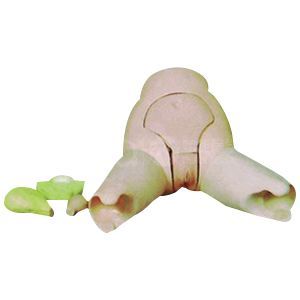
Fundus evaluation trainer BIX-F31 — normal, 1-hour, day-2 and week-2 postpartum uteri, plus firm and soft variants for massage practice.
...
BIX-F31 Postpartum Fundus Model: A Three-Station Lesson Plan
Short answer: BIX-F31 is a pelvic model for postpartum uterine fundus assessment and fundal massage. The page lists six interchangeable uteri — normal, first-hour postpartum, second-day postpartum, second-week postpartum, a firm well-contracted uterus and a soft poorly contracted uterus — plus movable hip joints and an accessible vaginal orifice. That set lets a teacher run the same check on six different clinical pictures in one session, which is exactly what involution teaching needs.
Key takeaways
- Six uteri, one model: the clinical picture changes by swapping the insert, not by buying another manikin.
- Time is built in: first hour, day two and week two let trainees feel how involution actually progresses.
- Tone is separable from time: a firm and a soft uterus at the same postpartum stage teach the difference between a normal and an atonic fundus.
- Positioning is realistic: movable hips and an expandable vaginal orifice support the actual examination posture.
- Packaging is unpublished: carton quantity, size and gross weight all read "not available".
The model at a glance
| Item | Published detail |
|---|---|
| Model | BIX-F31 |
| Category | Pediatrics & GYN Models → Labor Mechanisms and Skills Training |
| Training focus | Postpartum fundus assessment and fundal massage |
| Uterus inserts | Normal; postpartum 1 hour; postpartum day 2; postpartum week 2; callous uterus with good contraction; soft uterus without good contraction |
| Positioning | Movable hip joint; correct body position can be set |
| Access | Expandable vaginal orifice; labia minora can be separated |
| Carton quantity / size / weight | Not available |
| Price | Not published — quotation required |
What each uterus insert teaches
| Insert | What the trainee should notice |
|---|---|
| Normal uterus | The baseline: size, consistency and position before pregnancy changes the picture. |
| Postpartum, first hour | Fundus height and firmness immediately after delivery — the window when most bleeding begins. |
| Postpartum, day 2 | The expected descent; comparing it with the first-hour insert makes involution tangible. |
| Postpartum, week 2 | The later stage, when the fundus is no longer palpable abdominally in many women. |
| Firm, well-contracted | What a reassuring fundus feels like, and how massage maintains it. |
| Soft, poorly contracted | The atonic fundus: the finding that triggers massage, uterotonics and escalation. |
Three stations, 45 minutes
- Station 1 — locate and describe (12 min). With the first-hour uterus in place, each trainee finds the fundus, states its height relative to the umbilicus and describes consistency in two words. No massage yet.
- Station 2 — compare across time (15 min). Swap to day 2 and week 2 inserts. Ask the trainee to rank them by height and explain what changed. This is the step that turns a single finding into a trend.
- Station 3 — massage on a soft uterus (18 min). Swap to the soft, poorly contracted insert. Trainee performs fundal massage, explains what they are feeling for, and states the escalation threshold out loud.
Run the stations in that order. Starting with the soft uterus teaches panic; starting with the normal one teaches a baseline against which the abnormal becomes obvious.
What the evidence says about postpartum simulation
Postpartum haemorrhage is the reason fundus assessment is drilled, and the simulation literature is unusually practical. A follow-up study of self-perceived long-term transfer after postpartum haemorrhage simulation training found that clinicians retained and used the sequence months later, which supports repeated station practice rather than a single lecture [1]. A 2026 report on how lifelike patient simulators are training US rural care teams describes the same logic in a low-volume setting: the team rehearses the rare emergency so that the first real case is not the first rehearsal [2]. A 2026 survey of postpartum haemorrhage self-efficacy among obstetric providers adds the missing link — confidence tracks recent practice, not years of experience [3].
The limitation is honest: BIX-F31 teaches assessment and massage, not haemorrhage management as a whole. There is no bleeding, no vital-sign change and no team communication built into the model. Use it inside a drill that includes those elements.
What the product page does not publish
| Not stated on the page | Why it matters before ordering |
|---|---|
| Insert material and cleaning method | Determines the wipe-down routine between trainees and the life of the inserts. |
| Whether inserts are sold separately | The soft uterus is the piece that wears; a replacement path matters. |
| Carton quantity, size and weight | All three read "not available"; needed for freight and storage. |
| Whether a stand or pelvis base is included | Affects bench height and examination posture. |
| Price at your quantity and lead time | Quotation item. |
Send those five questions to sophia@adahealthy.com with the model number BIX-F31 and your annual cohort size, and we will answer each one with the current supply data.
FAQ
Q1. What is BIX-F31 used for?
Postpartum uterine fundus assessment and fundal massage training, including palpation of fundal height and consistency.
Q2. How many uterus inserts are included?
Six are listed: normal, first-hour postpartum, day-2 postpartum, week-2 postpartum, a firm well-contracted uterus and a soft poorly contracted uterus.
Q3. Can the model be positioned for a realistic examination?
Yes. The hip joint is movable so the correct body position can be set, and the vaginal orifice expands with the labia minora separable.
Q4. Does it simulate bleeding?
No. The page describes assessment and massage only; postpartum haemorrhage and vital-sign changes are not listed.
Q5. What are the carton details?
Quantity per carton, package size and gross weight are all printed as "not available" and must be requested.
Q6. How do I get a price?
Email sophia@adahealthy.com with the model (BIX-F31), quantity and cohort size. Ask for the insert list and replacement pricing in the same message.
Request a quotation
Write to sophia@adahealthy.com for the BIX-F31 specification sheet and a quotation. If you run an obstetric skills course, mention that you also need a childbirth mechanism model and a newborn assessment trainer, so the stations share the same pelvic conventions.
References
- Self-perceived long-term transfer of learning after postpartum hemorrhage simulation training. International Journal of Gynecology & Obstetrics. 2018.
- How Lifelike Patient Simulators Are Training US Rural Care Teams for Emergencies. Journal of Medical Internet Research. 2026.
- Postpartum Hemorrhage-Specific Self-Efficacy Among Obstetric Healthcare Providers. Healthcare (Basel). 2026.

Marketing Center
Hong Kong, ChinaProduction Base
Shanghai, ChinaProducts
Contact Us
 Address: Hong Kong, China
 Phone:+86 13383897707
 Email:sophia@adahealthy.com
 Mobile:+86-0379-65160607
举报邮箱:sophia@adahealthy.com
举报电话:+86 19937901373
Social Media