

BIX/FT335 Guide: Advanced Full-Functional Neonatal Manikin for Nursing & CPR Training
Article tag: Fully functional neonatal advanced manikin BIX/FT335 FT335
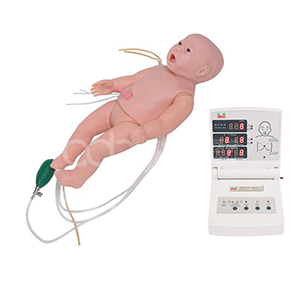
A training guide for the BIX/FT335 advanced full-functional neonatal manikin — newborn nursing care (temperature management, cord care, bathing) and neonatal resuscitation practice (initial steps, positive-pressure ventilation, 3:1 chest compressions with the two-thumb technique) built around the 2020 AHA neonatal resuscitation guidelines (Aziz et al., 2020). Simulation-based team training measurably improves neonatal resuscitation performance (Lindhard et al., 2021). Contact sophia@adahealthy.com for pricing.
...
Product Description
Model | BIX/FT335 — Advanced Full-Functional Neonatal Manikin |
Summary | Advanced neonatal manikin for nursing and CPR training: newborn care, airway, 3:1 compressions, team scenarios. For delivery rooms, NICUs, nursing schools. (155 chars) |
Price | On request |
Training Domains | Newborn nursing care; neonatal resuscitation (NRP/AHA 2020) |
Audience | Delivery rooms, NICUs, pediatric departments, nursing schools |
Positioning | One neonatal platform covering routine newborn care and emergency resuscitation |
Configuration note: exact modules (temperature monitoring, IV/injection sites, audible breath sounds) vary by configuration — confirm the module list with sophia@adahealthy.com.
1. Why Newborn Training Is a Life-and-Death Skill
Birth asphyxia is among the leading causes of newborn death worldwide, and neonatal mortality still accounts for nearly half of all deaths in children under five (WHO, 2024). The first minutes after birth decide the outcome: the 2020 AHA neonatal resuscitation guidelines define a stepwise sequence — initial assessment and warming → airway clearance and stimulation → positive-pressure ventilation (PPV) → chest compressions → epinephrine — in which each step must be executed correctly and without delay (Aziz et al., 2020).
The clinical reality makes simulation essential:
● Approximately
1 in 10 newborns
needs assistance to begin breathing after birth (PPV); a small minority (<1%) need chest compressions or epinephrine.
● These are
rare, high-stakes events
for any single provider — exactly the conditions under which skills decay fastest without rehearsal.
● Simulation-based
team training
in neonatal resuscitation measurably improves team and technical performance in evaluations 3–6 months after training (Lindhard et al., 2021).
A full-functional neonatal manikin lets delivery-room and NICU teams rehearse the entire sequence — from routine newborn assessment to full resuscitation — on a realistic, lifelike platform.
2. Training Domains on the FT335
Domain | Representative Skills | Evidence Anchor |
Newborn assessment | Tone, breathing/cry, heart rate check | Aziz et al., 2020 |
Temperature management | Warming, skin-to-skin, thermal protection | WHO newborn care |
Cord care & hygiene | Cord cleaning, bathing, diapering | WHO newborn care |
Feeding & positioning | Feeding posture, safe handling | WHO newborn care |
Neonatal resuscitation | Airway, PPV, 3:1 compressions, two-thumb technique | Aziz et al., 2020 |
Team scenarios | Delivery-room emergencies, NICU handover | Lindhard et al., 2021 |
Module list varies by configuration — confirm with your supplier.
3. Training Protocols
Station A: Routine Newborn Assessment — 10 min
1. Assess tone, breathing/cry, and heart rate within 30 seconds of birth.
2. Warm, dry, and position the newborn; maintain thermal protection.
3. Verbalize findings in a structured handover.
Station B: Airway & Positive-Pressure Ventilation — 15 min
1. Open the airway in neutral position; clear secretions if needed.
2. Deliver PPV at 40–60 breaths/min with correct mask seal and chest rise.
3. Instructor checks: seal, rate, chest rise, heart-rate reassessment.
Station C: Neonatal Chest Compressions — 15 min
1. Practice the
two-thumb technique
(encircling hands) at the correct landmark.
2. Maintain the neonatal
3:1 compression-to-ventilation ratio
(~120 events/min total).
3. Coordinate compressor and ventilator roles in pairs.
Station D: Full Neonatal Resuscitation Scenario — 25 min
1. Scenario: term newborn, no spontaneous breathing after birth → initial steps → PPV → reassess → compressions + PPV → epinephrine if indicated.
2. Team roles: leader, airway, compressions, medications, recorder.
3. Structured debrief: sequence, timing, ventilation quality, teamwork.
Refresher note: skills decay within months — BLS passing rates in nurses fell from 63% at 3 months to 58% at 12 months (Smith et al., 2008). Schedule quarterly neonatal scenario refreshers.
4. Assessment Design
Skill | Standard |
Initial assessment | Within 30 s: tone, breathing, heart rate |
PPV | 40–60 breaths/min, visible chest rise |
Compression technique | Two-thumb, correct landmark |
Compression ratio | 3:1 compressions:ventilation |
Scenario completion | Full NRP sequence without omitted steps |
5. Maintenance
Item | Frequency | Notes |
Manikin surface | After each class | Wipe with mild soap and damp cloth |
Airway & lungs | Monthly | Check valves and ventilation paths |
Electronics/modules | Per manual | Test configured modules before classes |
Storage | Always | Dry, dust-free; follow manual storage |
6. FAQ
Q1: What is the difference between FT335 and FT337? A: FT335 is the neonatal (newborn, first-28-days) platform for newborn nursing care and neonatal resuscitation with the 3:1 ratio. FT337 is the infant simulator for pediatric CPR and nursing at the infant age group, where resuscitation follows pediatric 15:2 or 30:2 ratios. Choose by the age group you train.
Q2: Does it support neonatal resuscitation training per NRP/AHA 2020? A: Yes — the FT335 supports the full sequence: initial assessment and warming, airway clearance, PPV, 3:1 chest compressions with the two-thumb technique, and team scenarios, following the 2020 AHA guidelines (Aziz et al., 2020).
Q3: What newborn nursing skills can be trained? A: Temperature management and thermal protection, cord care, bathing and hygiene, feeding posture, safe handling, and structured assessment — core routine-care skills for delivery rooms, maternity wards, and NICUs.
Q4: Why is simulation important for newborn care? A: Because resuscitation events are rare but high-stakes, and skills decay quickly without rehearsal. Simulation-based team training measurably improves neonatal resuscitation performance (Lindhard et al., 2021; Smith et al., 2008).
Q5: Who is the target audience? A: Delivery rooms, maternity wards, NICUs, pediatric departments, and nursing schools training newborn care and neonatal resuscitation.
Q6: What is the MOQ and delivery time? A: MOQ is 1 unit. Air freight: 7–10 business days; sea freight: 30–45 days. Email sophia@adahealthy.com for a quote.
References
Part 5: Neonatal Resuscitation: 2020 American Heart Association Guidelines for Cardiopulmonary Resuscitation and Emergency Cardiovascular Care — Aziz et al. (2020), Circulation 142(16 Suppl 2):S524–S550
Simulation-Based Neonatal Resuscitation Team Training: A Systematic Review — Lindhard et al. (2021), Pediatrics 147(4):e2020042010
Technology-Enhanced Simulation for Health Professions Education: A Systematic Review and Meta-analysis — Cook et al. (2011), JAMA 306(9):978–988
Evaluation of Staff's Retention of ACLS and BLS Skills — Smith et al. (2008), Resuscitation 78(1):59–65
Newborn Mortality — WHO Fact Sheet (2024)

Marketing Center
Hong Kong, ChinaProduction Base
Shanghai, ChinaProducts
Contact Us
 Address: Hong Kong, China
 Phone:+86 13383897707
 Email:sophia@adahealthy.com
 Mobile:+86-0379-65160607
举报邮箱:sophia@adahealthy.com
举报电话:+86 19937901373
Social Media