

BIX/ALS1200 Guide: Advanced Comprehensive Emergency Nursing Training Simulator — CPR, Nursing, Trauma & AED in One Manikin
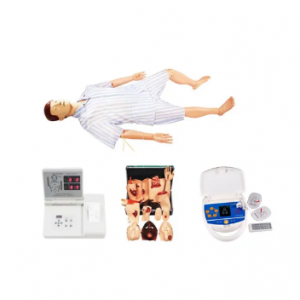
A training guide for the BIX/ALS1200 advanced comprehensive emergency nursing training simulator — a full-body adult manikin combining CPR with software scoring (training/exam/audit modes, printable transcripts), dynamic pupil and carotid signs, intubation with alarms, AED training following AHA and American Red Cross scenarios, full nursing-care skills, and 20+ replaceable trauma modules. Survival after VF cardiac arrest falls ~7–10% for every minute defibrillation is delayed (AHA, Part 4: The AED), and real-time feedback improves CPR quality (Gilfoyle et al., 2023; Meaney et al., 2013). Contact sophia@adahealthy.com for pricing.
...
Product Description
Model | BIX/ALS1200 — Advanced Comprehensive Emergency Nursing Training Simulator |
Summary | Full-body comprehensive emergency simulator: CPR with software scoring, intubation, AED scenarios, nursing care and 20+ trauma modules. (135 chars) |
Type | Full-body adult emergency & nursing training simulator |
Platforms | CPR (software) · Patient status · Intubation · AED · Nursing care · Trauma (20+ modules) |
Software | Installs on an existing office PC; student management, replay archive, multimedia/projector output |
Standards | AHA 2020 CPR targets; AHA & American Red Cross AED scenarios (10) |
Price | On request (higher than adult CPR models 800/800A; lower than system-level 8000) |
Audience | Nursing schools, EMT/EMS academies, trauma training centers, hospital nursing-skill centers |
Educational-use note: skill training simulator — educational equipment, not a medical device or pharmaceutical product, and contains no medicinal ingredients. Full specification (included components, consumables, language options for voice prompts) available from the supplier.
1. Why a Multi-Platform Simulator Is the Economics of Modern Training Centers
A training center running BLS, nursing, trauma, and AED courses traditionally needs several different manikins — one for CPR, one for nursing skills, one for trauma, one for AED practice. Each unit costs money, takes floor space, needs maintenance, and is used only a fraction of the timetable.
The ALS1200 collapses that problem: one full-body adult manikin, six training platforms — CPR with software assessment, patient-status simulation, intubation, AED, nursing care, and 20+ trauma modules. The economic argument for centers is straightforward:
One purchase
● replaces several single-purpose units
One footprint
● serves multiple courses
One skill set for instructors
● across the emergency curriculum
Shared PC software
● — no dedicated hardware beyond an existing office computer
2. The Evidence: Why These Training Platforms Matter
Each platform on the ALS1200 is anchored in direct evidence:
Platform | Evidence | Implication |
AED | Survival after VF arrest falls ~7–10% for every minute defibrillation is delayed; up to 90% survival reported when defibrillated within the first minute (AHA, Part 4: The AED) | AED fluency must be drilled before the moment it counts |
CPR quality | Compression depth, rate, and fraction are core quality components; feedback devices are supported during training (Meaney et al., 2013) | Software-scored CPR turns practice into objective data |
CPR feedback | Real-time feedback during simulated arrest is associated with higher CPR quality (Gilfoyle et al., 2023) | The software's instant scoring reinforces correct technique |
BLS context | AHA 2020: high-quality CPR is the strongest determinant of survival (Panchal et al., 2020) | Multi-platform training keeps the whole chain of survival in one lab |
Trauma skills | Hemorrhage-control training measurably raises skills across 35 studies; skills decay without practice (Consunji et al., 2024) | Replaceable trauma modules enable repeated, realistic drills |
Simulation overall | Technology-enhanced simulation yields large learning gains (effect sizes 1.09–1.20; 35,226 learners) (Cook et al., 2011) | One platform, many disciplines — simulation works |
3. The Six Training Platforms in Detail
Platform | What It Trains |
1. CPR with software scoring | Standard airway opening; real-time compression-rate control; three modes — practice, exam, and practical audit; adjustable session time; printable transcripts; voice prompts adjustable by language/volume |
2. Software system | Installs on an existing office PC: student management (name, number, archive), replay of recorded operations, multimedia teaching with projector output |
3. Patient status simulation | Pupil reflex: dynamic dilation/constriction before and after assessment; carotid pulse: automatic pulsation during compressions and after procedures, matching real responses |
4. Tracheal intubation | Correct/incorrect placement alarms with animation display |
5. AED training | Follows AHA and American Red Cross guidance across 10 AED scenarios; real AED operating interface, LED digital display, electrode-pad attachment sensing, adjustable volume with AUDIO jack |
6. Nursing care | Hair washing, face washing, arm venipuncture, deltoid/vastus lateralis injection, enema, male/female catheterization, male/female bladder irrigation, washing and dressing, limb joint exercises |
7. Trauma simulation (20+) | Face/forearm I–III degree burns, forehead laceration, open clavicular fracture with chest contusion, abdominal wound with exposed intestine, open fractures (humerus/hand/tibia/foot), gunshot wound (right palm), thigh metal-foreign-body injury, small-finger amputation, left thigh amputation, closed tibial fracture, contusions, and more |
4. Where the ALS1200 Sits in the BIX ALS Family
Model | Coverage | Best For |
800 / 800A / 850 | Adult CPR (voice/electronic) | Dedicated CPR training |
ALS880 | CPR + nursing + intubation + wound care (no trauma kit/AED) | Economy nursing-care programs |
ALS900 | CPR + trauma (16 modules) | Budget trauma training |
ALS1000 | CPR + intubation (Chinese-only voice prompts) | CPR-focused programs |
ALS1200 | CPR + nursing + trauma (20+) + AED + intubation (all-in-one) | Comprehensive emergency & nursing curricula |
8000 | System-level | Full simulation labs |
The ALS1200 is the highest-function single-manikin tier below system-level simulators — one unit covering the entire first-response chain.
5. Included Configuration (per manufacturer)
● Advanced resuscitation full-body model
● Luxury wheeled hard-shell carrying case
● Computer (optional — user-provided or optional purchase)
● CPR software (1 set)
● Resuscitation practice pad
● Barrier face shields (50)
● Replaceable lung bags (4 sets)
● Replaceable face skins (2)
● 2020 International CPR guidelines disc
● CPR textbook, manual, warranty card, certificate
Confirm the exact package and consumable part numbers with the specification sheet before ordering.
6. Teaching Protocols
Station A: Software-Scored CPR — 30 min
1. Run practice mode with real-time rate/depth guidance.
2. Switch to exam mode; instructor sets pass criteria.
3. Print transcript for each student; review replay together.
Station B: Patient Assessment — 15 min
1. Pupil reflex before/after procedures.
2. Carotid pulse checks during and after compressions.
Station C: Airway & AED — 30 min
1. Intubation practice with alarm feedback.
2. AED scenarios (electrode placement, shock advisory) across the 10 AHA/ARC scenarios.
Station D: Nursing & Trauma Rotations — 45 min
1. Nursing stations: injection sites, catheterization, bladder irrigation.
2. Trauma stations: rotate 20+ modules for wound assessment and hemorrhage control.
3. Quarterly refreshers — trauma and CPR skills decay without practice (Consunji et al., 2024; Smith et al., 2008).
7. Assessment & Maintenance
Assessment
Criterion | Standard |
CPR quality | AHA 2020 targets; software pass threshold per course |
Intubation | Correct placement without alarm |
AED sequence | Electrode placement, safety check, shock delivery per scenario |
Nursing skills | Checklist-based (aseptic technique where relevant) |
Trauma response | Assessment → control → dressing sequence |
Maintenance
Item | Frequency | Notes |
Face skins / lung bags | Per manual | Replaceable; order spares |
Trauma modules | After each use | Clean and store per manual |
Software | Per update | Runs on office PC; no dedicated hardware |
Storage | Always | Wheeled hard case included |
8. FAQ
Q1: How is the ALS1200 different from ALS880/ALS900/ALS1000? A: ALS1200 is the all-in-one model: CPR + nursing care + 20+ trauma modules + AED scenarios + intubation. ALS880 covers CPR + nursing + intubation + wound care without the trauma kit or AED; ALS900 is CPR + 16 trauma modules; ALS1000 is CPR + intubation. If your curriculum spans nursing, trauma, and AED, ALS1200 replaces several machines with one.
Q2: What computer does the software need? A: The CPR software installs on an existing office PC — no dedicated hardware. It manages students (name, number, archive), replays recorded operations, and outputs multimedia to a projector.
Q3: Is the AED training module guideline-compliant? A: The AED scenarios follow AHA and American Red Cross guidance across 10 scenarios, with a real AED-style interface, LED display, electrode attachment sensing, and adjustable audio.
Q4: Can one manikin really serve both nursing and trauma classes? A: Yes — that is the design premise. The nursing platform covers venipuncture, injections, catheterization, bladder irrigation, hygiene care, and limb exercise; the trauma platform provides 20+ replaceable wound modules. One unit can run four different course types in one week.
Q5: Why should a center pay more than for a single-purpose CPR manikin? A: Because one multi-platform unit replaces several single-purpose units — fewer purchases, less floor space, and one software system across disciplines. For a center running multiple courses, the all-in-one unit is usually the lower total cost.
Q6: What is the price, MOQ, and delivery time? A: Price is on request (positioned between adult CPR models and the system-level tier). MOQ is 1 unit. Air freight: 7–10 business days; sea freight: 30–45 days. Email sophia@adahealthy.com for the specification sheet and quote.
References
Part 4: The Automated External Defibrillator — Key Changes in the Guidelines (2000), Circulation 102(Suppl 1):I-60
Part 3: Adult Basic and Advanced Life Support — 2020 AHA Guidelines for CPR and ECC — Panchal et al. (2020), Circulation 142(16 Suppl 2):S366–S468

Marketing Center
Hong Kong, ChinaProduction Base
Shanghai, ChinaProducts
Contact Us
 Address: Hong Kong, China
 Phone:+86 13383897707
 Email:sophia@adahealthy.com
 Mobile:+86-0379-65160607
举报邮箱:sophia@adahealthy.com
举报电话:+86 19937901373
Social Media