

What Is a Clinical Model? A Guide to Medical Training Models, Manikins, and Simulation
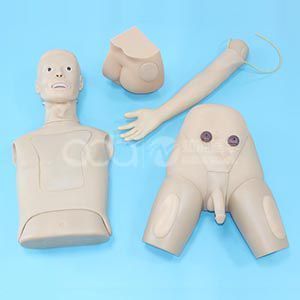
A clinical model (clinical training model) is a physical or virtual simulation device used in medical education to practice clinical skills without risk to patients — from anatomical models and skill trainers to full-function manikins and scenario simulators. Meta-analyses show simulation-based training outperforms traditional clinical education, and medical educators call simulation an ethical imperative. For clinical model procurement, contact sophia@adahealthy.com.
...
Product Description
Product Line | BIX Clinical Training Models |
Summary | BIX clinical training models — anatomical models, skill trainers, and full-function manikins for nursing, airway, CPR, obstetric, and skeletal education. (148 chars) |
Categories | Nursing (H series), airway (J series), CPR/ACLS, obstetric (F series), skeletal (A series) |
Fidelity Range | Anatomical display → skill trainer → electronic manikin → comprehensive system |
Application | Medical, nursing, EMS, and allied health education |
Certification | ISO 9001 / ISO 14001 / ISO 45001 manufacturing |
1. What a Clinical Model Actually Is
A clinical model — also called a clinical training model, medical education model, or simulation model — is a device used to teach and practice clinical skills outside the clinical setting. It replaces the patient as the practice surface, so learners can rehearse skills until competent, without risk to a real person.
Clinical models serve four distinct purposes:
Purpose | What It Delivers | Example |
Anatomical understanding | 3D representation of structures for study and demonstration | Skeleton, torso, organ models |
Skill acquisition | Repeated practice of a procedure on realistic surfaces | Venipuncture arm, airway trainer, suture pad |
Objective assessment | Measurable performance feedback | Electronic CPR manikin with depth/rate display |
Scenario training | Full clinical situations with team dynamics | ACLS mega-code, obstetric emergency simulation |
The unifying principle comes from the BEME systematic review: simulation-based medical education is effective when it combines feedback, repetitive practice, and curriculum integration (Issenberg et al., 2005) — which is exactly what a well-chosen clinical model is built to provide.
2. The Fidelity Spectrum: From Display Model to Simulator
Clinical models range along a fidelity continuum — higher fidelity means greater realism and feedback, but also higher cost (Maran & Glavin, 2003). Choosing the right point on the spectrum is a curriculum decision, not just a budget decision.
Level | Model Type | Typical Use | Fidelity |
1 | Anatomical display model | Structure teaching, patient education | Visual |
2 | Part-task skill trainer | Single-procedure repetition (injection, intubation, suturing) | Tactile |
3 | Electronic feedback manikin | Measured skills (CPR quality, IV access) | Tactile + data |
4 | Comprehensive simulation system | Full scenarios (airway + ECG + defib + auscultation) | Multi-system |
Key insight: higher fidelity does not automatically mean better learning. Evidence supports matching fidelity to the learning objective — a venipuncture trainer does not need ECG simulation, and a code-team drill needs more than a static arm (Maran & Glavin, 2003).
3. Why Clinical Models Are Evidence-Based, Not Optional
Four lines of evidence make clinical models a standard of medical education, not an accessory:
1. Effectiveness. A meta-analysis of over 600 studies found technology-enhanced simulation (manikins, trainers, virtual reality) consistently improves knowledge, skills, and behaviors compared with no intervention, with large effects for skills outcomes (Cook et al., 2011).
2. Superiority over traditional clinical exposure. Simulation with deliberate practice outperforms traditional clinical education in acquiring procedural skills — learners reach competency faster and more reliably (McGaghie et al., 2011).
3. The ethical imperative. "See one, do one, teach one" means practicing on real patients. Simulation lets learners make and correct errors in a safe environment — which leading educators frame as an ethical obligation, not a convenience (Ziv et al., 2003).
4. Patient safety. Standardized, checklist-driven practice — the same principle behind checklists that reduced surgical complications worldwide (Haynes et al., 2009) — is exactly what skills lab training instills before clinical exposure.
4. How to Choose the Right Clinical Model
A 4-Step Selection Framework
Step | Question | Decision Guide |
1 | What skill must the learner master? | Match model type to the skill (injection → trainer; code → manikin) |
2 | What feedback is required? | Objective assessment → electronic; practice only → mechanical |
3 | What is the trainee volume? | Mass training → durable low-cost units; small groups → higher fidelity |
4 | What is the total cost of ownership? | Include consumables, replacement parts, and service life (8–10 years typical) |
Budgeting Insight
A common institutional pattern is a mixed-fidelity fleet: durable mechanical models for mass practice, one electronic assessment model per skill station, and a comprehensive system for scenario courses. This delivers evidence-based training (feedback + repetition) while controlling total cost.
5. The BIX Clinical Model Lineup
Category | Series | Example Models | Training Focus |
Nursing | H / HS | H130B full-function manikin, HS3 venipuncture arm, H10 pressure ulcer | Basic nursing, injection, wound care |
Airway | J | J5S/J51 electronic trainers, J3A infant airway | Intubation, esophageal prevention |
CPR / ACLS | CPR / ACLS | CPR100A–CPR480, ACLS150, ACLS170B | BLS/PALS/NRP/ACLS |
Obstetric | F | F55 childbirth, FS gynecological exam, F132 umbilical cord | Delivery and obstetric skills |
Skeletal | A | A1004, A1031, A1002 | Osteology and anatomy teaching |
For model selection, configuration, and institutional pricing across categories: sophia@adahealthy.com.
6. FAQ
Q1: What is the difference between a clinical model and a simulator? A: The terms overlap. A clinical model generally refers to any physical training device (including anatomical display models); a simulator more specifically implies functional feedback — measurement, alarms, or physiological response. All simulators are clinical models, but not all clinical models are simulators.
Q2: Why can't students just learn on real patients? A: Because practice on patients carries risk and is ethically problematic — educators describe simulation as an ethical imperative (Ziv et al., 2003). Models allow unlimited, safe, repeatable practice with feedback, which is precisely what evidence shows builds durable skills (Cook et al., 2011; McGaghie et al., 2011).
Q3: What is the right fidelity level for our program? A: Match fidelity to the learning objective (Maran & Glavin, 2003): a procedural skill needs a tactile trainer, an assessment program needs electronic feedback, a scenario course needs a comprehensive system. Most institutions deploy a mix rather than a single fidelity.
Q4: How long do clinical models last? A: Quality models have a service life of 8–10 years under normal use, with consumables (lung bags, skins, tubes) replaced on usage schedules. Ask suppliers for consumable price lists and replacement intervals before purchase.
Q5: Do models require instructor training to operate? A: Basic models are self-explanatory; electronic systems include manuals and may offer on-site installation training for multi-unit orders. Always confirm included accessories and training support with the supplier.
Q6: What is the MOQ and delivery timeline? A: Typically MOQ 1 unit, air freight 7–10 business days; institutional orders of 3+ units qualify for consolidated sea freight (30–45 days). Email sophia@adahealthy.com. for a formal quotation.
References
Features and Uses of High-Fidelity Medical Simulations That Lead to Effective Learning: A BEME Systematic Review — Issenberg etal. (2005), Med Teach 27(1):10–28
Technology-Enhanced Simulation for Health Professions Education: A Systematic Review and Meta-Analysis — Cook et al. (2011), JAMA 306(9):978–988
Does Simulation-Based Medical Education With Deliberate Practice Yield Better Results Than Traditional Clinical Education? — McGaghie et al. (2011), Acad Med 86(6):706–711
Simulation-Based Medical Education: An Ethical Imperative — Ziv et al. (2003), Acad Med 78(8):783–788
Low- to High-Fidelity Simulation: A Continuum of Medical Education? — Maran & Glavin (2003), Med Educ 37(s1):22–28
A Surgical Safety Checklist to Reduce Morbidity and Mortality in a Global Population — Haynes et al. (2009), N Engl J Med 360(5):491–499

Marketing Center
Hong Kong, ChinaProduction Base
Shanghai, ChinaProducts
Contact Us
 Address: Hong Kong, China
 Phone:+86 13383897707
 Email:sophia@adahealthy.com
 Mobile:+86-0379-65160607
举报邮箱:sophia@adahealthy.com
举报电话:+86 19937901373
Social Media