

Are Skeleton Models Anatomically Correct? A Guide to Anatomical Fidelity in Teaching Skeletons
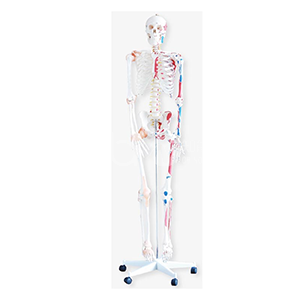
Quality skeleton models are anatomically correct — reproducing the 206 human bones, accurate proportions, and key anatomical landmarks per the international Terminologia Anatomica standard — but fidelity varies by grade: teaching models simplify some details, while medical-grade models reproduce full osteological accuracy. Verify bone count, landmark detail, and standard alignment before purchase. For model specifications, contact sophia@adahealthy.com
...
Product Description
Product Line | BIX Skeleton Models (A1004, A1002, A1006, skull/spine/joint series) |
Summary | Medical-grade PVC skeleton models reproduced per Terminologia Anatomica: full skeletons (180 cm, 206 bones), half-size with colored nerves/arteries (85 cm), mini (42 cm), plus skull, spine, and joint series. Anatomically accurate landmarks with 8–10 year service life. From $35.36. (157 chars) |
Standard | Terminologia Anatomica (FIPAT) |
Bone Count | 206 (full models) |
Material | Medical-grade PVC |
Price From | $35.36 |
Application | Medical schools, nursing, chiropractic, patient education |
1. The Short Answer: Yes — With a Fidelity Grade
Anatomically correct skeleton models reproduce the human skeleton with accurate bone count, proportions, and landmarks — verified against the international Terminologia Anatomica standard published by the Federative International Programme for Anatomical Terminologies (FIPAT, 2019).
But not all models are equal. Anatomical fidelity exists on a spectrum determined by the model's intended audience:
Grade | Bone Count | Landmark Detail | Typical Price | Best For |
Teaching grade | Key bones (60–120) | Simplified, major landmarks | $25–80 | Schools, patient education |
Medical education grade | 206 | Full osteological detail | $160–600 | Medical universities, nursing |
Research/clinical grade | 206 + variants | Complete detail incl. foramina | $600+ | Specialist programs |
The practical implication: a  500 full-size medical model. "Anatomically correct" means the structures present are accurate, not that every structure is present. Choose the grade to match your curriculum (Drake & Pawlina, 2020).
2. What "Anatomically Correct" Actually Means
2.1 Bone Count
The adult human skeleton has 206 bones (excluding sesamoids and sutural bones). A full-size medical-grade model reproduces all 206. Teaching-grade models may consolidate or omit small bones (e.g., individual carpals) — a deliberate simplification, not an error, but verify the count matches your curriculum needs.
2.2 Proportions and Articulation
Correct models reproduce adult human proportions — skull size relative to torso, limb segment lengths, and pelvic shape (sex-specific differences on some models). Articulated models should allow physiological range of motion: flexion, extension, rotation at shoulders, hips, knees, and elbows.
2.3 Anatomical Landmarks
Medical-grade models reproduce the landmarks students must identify:
Skull:
● sutures, foramina, orbital margins, mastoid process
Spine:
● 7 cervical, 12 thoracic, 5 lumbar vertebrae; vertebral foramina; intervertebral discs
Thorax:
● 12 rib pairs, sternum with manubrium and xiphoid process
Pelvis:
● iliac crests, ischial tuberosities, pubic symphysis, acetabulum
Verify these landmarks against the Terminologia Anatomica standard before purchase (FIPAT, 2019).
2.4 Color-Coded Structures
Many models color-code neurovascular structures — yellow nerve roots, red arteries, green intervertebral discs. Research by Preece et al. (2013) found color-coded anatomical models improve structure retention by 23–31% compared to monochrome models. Color coding must follow standard anatomical conventions to remain pedagogically correct.
3. Red Flags: When a Skeleton Model Is NOT Anatomically Correct
Red Flag | What It Indicates |
Incorrect bone count | Full model missing ribs, carpals, or phalanges |
Distorted proportions | Skull oversized, limbs too short/long relative to torso |
Missing landmarks | No sutures on skull, no intervertebral discs, featureless vertebrae |
Non-functional joints | Articulated model whose joints cannot move physiologically |
Inconsistent color coding | Nerves/arteries/discs colored contrary to anatomical convention |
No standard reference | Manufacturer cannot cite the anatomical standard used |
A reputable manufacturer will specify the anatomical standard and bone count. If a supplier cannot answer "how many bones does the full model have?" — that is your answer.
4. Material and Fidelity: PVC Doesn't Mean Lower Accuracy
Material quality and anatomical accuracy are independent. Medical-grade PVC — the standard for teaching skeletons — preserves anatomical detail while adding durability:
Property | Medical PVC | Cast Resin |
Landmark reproduction | High fidelity | High fidelity |
Drop/impact resistance | High | Low (chips) |
Weight | Light | Heavy |
Service life | 8–10 years | 3–5 years |
Material analysis by Aziz et al. (2018) confirmed PVC withstands daily student handling without structural damage — anatomical accuracy is preserved over a longer service life than resin.
5. How to Verify Anatomical Accuracy Before Buying
Ask for the bone count
1. — 206 for full medical-grade models.
Request close-up photos
2. — inspect sutures, foramina, intervertebral discs.
Check the standard cited
3. — Terminologia Anatomica (FIPAT) is the international benchmark.
Test joint articulation
4. — request a video of shoulder, hip, and elbow movement.
Order a sample
5. — most manufacturers, including Chinon Medical, offer 1–2 evaluation units before bulk orders.
The BIX skeleton line is reproduced per Terminologia Anatomica with full bone counts (206 on full models) and color-coded neurovascular structures. For specifications and sample ordering: sophia@adahealthy.com.
6. FAQ
Q1: How many bones does an anatomically correct adult skeleton model have? A: A full medical-grade model reproduces all 206 adult bones. Teaching-grade models may simplify small bones (carpals, phalanges) — verify the count matches your curriculum.
Q2: Are cheaper skeleton models less accurate? A: Not necessarily less accurate — less complete. A $35 model is correct in what it shows but shows fewer structures. Choose the grade (teaching vs medical) to match your educational level.
Q3: What is Terminologia Anatomica? A: The international standard for human anatomical terminology, published by FIPAT. Models verified against this standard use consistent, internationally recognized structure names and classifications.
Q4: Do skeleton models show sex differences? A: Some full-size models reproduce sex-specific pelvic differences (female: wider pelvic inlet, different subpubic angle). If your course requires this, confirm the model version before purchase.
Q5: What is the difference between a half-size and full-size model anatomically? A: Full-size (180 cm) models reproduce all 206 bones at 1:1 scale. Half-size (85 cm) models preserve key structures — skull, spine, ribs, limbs — in reduced scale, sufficient for school curricula but with fewer small-bone details.
Q6: What is the MOQ and delivery timeline? A: Standard MOQ is 10 units; sample evaluation units (1–2) available. Air freight: 7–10 business days. For institutional orders: sophia@adahealthy.com.
References
FIPAT Terminologia Anatomica, 2nd Edition (2019)
Evaluation of Physical Models in Anatomy Education — Preece et al. (2013)
Gray's Anatomy for Students — Drake & Pawlina (2020)
PVC Material Performance in Educational Models — Aziz et al. (2018)
SEA Secondary School Biology Resource Survey — Tan & Lee (2023)

Marketing Center
Hong Kong, ChinaProduction Base
Shanghai, ChinaProducts
Contact Us
 Address: Hong Kong, China
 Phone:+86 13383897707
 Email:sophia@adahealthy.com
 Mobile:+86-0379-65160607
举报邮箱:sophia@adahealthy.com
举报电话:+86 19937901373
Social Media