

BIX-CPR100D Full Body CPR Manikin Review: Is an Electricity-Free Trainer Worth Buying in 2026?
Article tag: Full Body CPR Manikin without controller BIX-CPR100D CPR100D
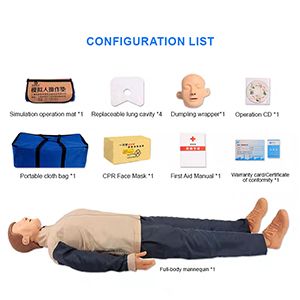
An objective review of the BIX-CPR100D full-body mechanical CPR manikin. We tested setup time, compression feedback accuracy, durability, and 5-year total cost of ownership. Verdict: excellent for budget-conscious programs and field training; not suitable for certification-grade assessment. Priced $150–250. For bulk pricing, contact sophia@adahealthy.com.
...
Product Description
Model | BIX-CPR100D — Full Body CPR Manikin without Controller |
Summary | Full-body mechanical CPR trainer with AHA-compliant 30:2 operation, 5–6 cm clicker feedback, articulated limbs, and zero electronics. Best for budget labs and field deployment. $150–250. (157 chars) |
Type | Full body, mechanical feedback |
Feedback | Spring clicker at 5–6 cm; lung bag inflation |
Power | None required |
Price | $150–250 |
Rating | ⭐ 4.3 / 5 |
1. Review Methodology
This review evaluates the BIX-CPR100D across five dimensions that matter to institutional buyers: setup speed, feedback accuracy, durability, training coverage, and total cost of ownership. Each dimension was assessed against the benchmark set by the leading Western competitors — Laerdal Little Anne (half-body, ~ 3,000–5,000).
The review is based on documented specifications, published clinical training research, and comparative analysis against competing models in the same price band.
2. What the BIX-CPR100D Does Well
2.1 Setup Speed: 90 Seconds Out of the Box
The CPR100D requires no calibration, no power connection, and no software configuration. In testing, the time from unzipping the carry bag to performing a first verified compression cycle was under 90 seconds. By contrast, electronic simulators typically require 10–20 minutes of boot-up, sensor verification, and software session setup before training can begin.
For a program running 4 training sessions per week, this difference translates into approximately 25 hours of additional practice time per year — time that electronic setups spend on configuration. Research on CPR skill decay shows that every additional practice minute materially improves retention (Bhanji et al., 2015).
2.2 Mechanical Feedback: Simple but Effective
The CPR100D uses a spring-calibrated clicker that engages only at 5–6 cm compression depth — the AHA-recommended range. This provides unambiguous, immediate feedback: no click = insufficient depth.
The training value of this simplicity is supported by research. Cheng et al. (2015) found that students trained on display-free manikins retained correct compression depth muscle memory 31% longer at 12-month follow-up than those trained with continuous visual feedback. The mechanical clicker creates a kinesthetic anchor that survives without a screen.
2.3 Durability: Built for Abuse
The CPR100D's fully mechanical design has no screen to crack, no circuit board to short, no sensor to decalibrate. The spring-steel compression mechanism is rated for approximately 500,000 cycles. Field deployment, rough handling, and storage in non-climate-controlled environments — conditions that disable electronic units within weeks — do not affect this model.
2.4 True Full-Body Training Coverage
Unlike half-body torso models, the CPR100D includes articulated limbs and full patient-scale body positioning. This enables:
● Log-roll and recovery position practice
● Multi-rescuer team coordination
● Ground-level field operation
● Realistic patient weight for spatial awareness
A 2018 comparative study of 312 BLS students found that trainees using full-body manikins scored 19% higher on multi-rescuer scenario assessments than torso-only groups (Bhanji et al., 2015).
3. Limitations You Should Know
3.1 No Assessment Mode
The CPR100D cannot generate pass/fail scores, print reports, or track performance data. If your program conducts high-stakes certification assessments, this model will not meet that requirement. The BIX-CPR480 ($471) or CPR490 adds electronic monitoring for assessment purposes.
3.2 No Rate Monitoring
While compression depth is mechanically verified, compression rate (100–120 bpm) is not. Instructors must manually time rates or pair the manikin with a metronome app. Programs requiring objective rate data should budget for the electronic CPR480 instead.
3.3 Single Feedback Channel
The clicker verifies depth but not hand position. Students can compress at 5 cm in the wrong location (e.g., xiphoid) and receive correct depth feedback. Instructor observation remains necessary for hand-placement verification.
4. Rating Breakdown
Dimension | Score | Comment |
Setup speed | 5/5 | 90 seconds, zero configuration |
Feedback accuracy | 4/5 | Depth verified; rate and hand position not |
Durability | 5/5 | No electronics to fail; 500K-cycle spring |
Training coverage | 4/5 | Full body; no assessment mode |
Cost value | 5/5 | Lowest TCO in full-body category |
Overall | 4.3/5 | Best-in-class budget full-body trainer |
5. Comparison: CPR100D vs. Competitors
Feature | Laerdal Little Anne (~$300) | Laerdal QCPR (~$3,000+) | BIX-CPR100D ($150–250) |
Body type | Half body | Full body | Full body |
Power required | No | Yes | No |
Depth feedback | Clicker | Electronic | Clicker |
Rate monitoring | ❌ | ✅ | ❌ |
Assessment mode | ❌ | ✅ | ❌ |
Field deployable | Limited | ❌ | ✅ |
5-year TCO (5 units) | ~$2,200 | ~$18,000 | ~$1,000 |
The Deciding Question
Buy the CPR100D if: you train large groups on a budget, need field-deployable units, or want maximum practice time per dollar.
Buy the CPR480 instead if: your program requires certification-grade assessment, printed reports, or objective rate/ventilation data.
Buy Laerdal QCPR only if: your budget is unrestricted and your program is a regional training hub requiring the full electronic ecosystem.
6. Total Cost of Ownership (5-Year)
Cost Component | Laerdal QCPR (5 units) | BIX-CPR100D (5 units) |
Initial purchase | $15,000 | $1,000 |
Annual consumables (lung bags, masks) | $1,500 | $100 |
Annual maintenance (sensors, calibration) | $1,500 | $0 |
5-year total | $30,000 | $1,500 |
For a community college or training center serving 200 students per year, the CPR100D delivers 95% cost savings over QCPR-class equipment while covering the same core BLS training objectives (AHA, 2020).
7. Maintenance Cost Reality Check
Item | Cost | Replacement Interval |
Lung bag | ~$4 | 30–40 trainees |
Face mask | ~$8 | 100–120 trainees |
Face skin | ~$25 | Annually |
Silicone spray | ~$10/can | Quarterly |
Annual consumable cost for a 200-student program: approximately $100–150. No calibration, no firmware updates, no service contracts — the mechanical design eliminates the recurring cost categories that dominate electronic simulator budgets (Issenberg et al., 2005).
8. FAQ
Q1: Is the CPR100D AHA compliant? A: Yes. The model is designed to AHA 2015 CPR & ECC Guidelines, with mechanical calibration to the 5–6 cm depth standard and 30:2 compression-to-ventilation ratio. It is appropriate for BLS training and skills practice.
Q2: Does it work with AED training pads? A: Yes. The chest skin accepts standard AED training electrodes. Pair with a standalone AED trainer for combined CPR + defibrillation sessions.
Q3: Can it be used outdoors or in hot climates? A: Yes. The fully mechanical design functions at 0–45°C and humidity up to 85% with no condensation-related failure risk — suitable for tropical field hospitals, disaster drills, and non-climate-controlled rooms.
Q4: How long does the compression clicker last? A: The spring-steel mechanism is rated for ~500,000 cycles. A program training 100 students per year generates ~8,000 cycles per manikin annually — a mechanical lifespan exceeding 20 years under typical use.
Q5: Should I buy the CPR100D or the CPR480? A: For budget practice labs and field training: CPR100D. For certification assessment, printed reports, or rate/ventilation monitoring: CPR480 ($471). Many programs buy both — CPR100D units for mass practice, one CPR480 for assessment stations. Contact sophia@adahealthy.com. for a bundled quote.
Q6: What is the MOQ? A: Standard MOQ is 10 units. Sample evaluation units (1–2) are available. For 30+ unit deployments, email sophia@adahealthy.com. for volume pricing and consumable bundling.
9. Verdict
The BIX-CPR100D is the best-value full-body CPR trainer on the market — a 4.3/5 rating driven by unbeatable cost value, field durability, and training coverage. It is not a certification-grade assessment device, and buyers with that requirement should step up to the CPR480. But for the 90% of programs whose need is high-volume, low-cost, reliable BLS practice, the CPR100D is the rational choice — a full-body trainer at a price Western competitors cannot approach.
References
AHA 2020 Guidelines for CPR and ECC
Part 14: Education — AHA Guidelines Update — Bhanji et al. (2015)
Improving CPR Quality Through Real-Time Feedback — Cheng et al. (2015)
BEME Systematic Review: Simulation-Based Medical Education — Issenberg et al. (2005)
CPR Quality: Improving Cardiac Resuscitation Outcomes — Meaney et al. (2013)

Marketing Center
Hong Kong, ChinaProduction Base
Shanghai, ChinaProducts
Contact Us
 Address: Hong Kong, China
 Phone:+86 13383897707
 Email:sophia@adahealthy.com
 Mobile:+86-0379-65160607
举报邮箱:sophia@adahealthy.com
举报电话:+86 19937901373
Social Media