

Teaching Bovine Acupuncture with the ADA-603 Cattle Model
Article tag: ADA-603 cattle acupuncture model bovine acupoints veterinary acupuncture training large animal a
What the ADA-603 cattle acupuncture model teaches, how 68 numbered bovine points are used in training, and where a physical model stops and palpation begins.
...

Teaching Bovine Acupuncture with the ADA-603 Cattle Model
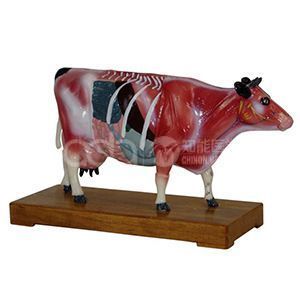
Large-animal acupuncture is taught in rooms, not in barns. That single constraint explains why a physical bovine model earns its place in a veterinary curriculum: a student cannot repeatedly find a point on a standing cow while a lecturer explains, but a model can be passed around, labelled and examined. The ADA-603 is a PVC cattle model with 68 useful acupuncture points marked by numerals on the right side of the body, intended as a veterinarian's reference and a classroom teaching aid.
What the model provides
| Feature | Detail |
|---|---|
| Model | ADA-603 |
| Subject | Cattle, standing, on a wooden-look base |
| Points marked | 68 useful acupuncture points, right side |
| Labelling | Numbered markers |
| Material | PVC |
| Intended user | Veterinary reference, teaching |
| Quantity per carton | 10 |
| Package size | 58 × 37 × 29 cm |
| Gross weight | 6 kg |
The numbering is the teaching mechanism. A lecturer can call a number, ask the student to locate it, and then discuss the indication without the student hunting through a chart. That drill is difficult to run on a live animal and impossible to run repeatedly on a photograph.
Why point location dominates the curriculum
Veterinary acupuncture evidence is uneven, and the honest position is that the literature supports some applications while leaving many claims unproven [1]. That makes technique and safety the defensible core of a training course: the student should leave able to locate a point reproducibly, know the underlying anatomy, and know when not to needle.
A model supports the first of those three. It does not teach depth, angle or tissue response — the parts that require an animal or a cadaver. The practical division is therefore:
- Model: point identification, numbering, regional anatomy, examination practice.
- Cadaver or live animal: depth, angle, response, and the decision to stop.
Courses that use a model as the sole practical experience tend to produce students who can point at a location but hesitate at the needle. Build at least one supervised animal session into the course, or state clearly in the syllabus that the model is a location aid only.
A 40-minute point-location session
- Orient the group (5 min). Name the regions marked on the model: head and neck, trunk, hindlimb, forelimb.
- Number drill (10 min). Call ten numbers at random; students locate each on the model and name the region.
- Reverse drill (10 min). Name a clinical indication; students propose a point and justify the choice.
- Palpation translation (10 min). For five points, describe the landmark a clinician would feel on a standing animal.
- Record (5 min). Each student writes the five points and one caution for each.
Step four is the one most often skipped, and it is the step that converts a numbered model into clinical behaviour.
Specification and handling notes
PVC models are durable but not indestructible. Keep the model out of direct sun, clean with a damp cloth rather than solvent, and store it so the legs and base are not load-bearing. At 6 kg gross per carton of ten, the unit weight is manageable for shelf storage, and the 58 × 37 × 29 cm carton is the shipping size rather than the display footprint.
If the model will be used in a barn or during field teaching, ask the supplier about a carry case; the base is the part most likely to be damaged in transport.
Quotation and specification. Current pricing, carton quantity and delivery for the ADA-603 are available from sophia@adahealthy.com.
FAQ
Q1. How many points does the ADA-603 mark? 68 useful acupuncture points, numbered, on the right side of the cattle body.
Q2. Is it life-size? It is a teaching model on a base, sized for desk and classroom demonstration rather than for simulating a full standing animal.
Q3. What material is it made from? PVC, with a wooden-look base.
Q4. Can it replace practical training on animals? No. It teaches point location and regional anatomy; depth, angle and tissue response require a cadaver or supervised animal session.
Q5. Who is the model intended for? Veterinarians using acupuncture as a reference aid, and veterinary or technician students learning bovine point location.
Q6. How is it packed? Ten units per carton, 58 × 37 × 29 cm, 6 kg gross.
Product page: Teaching Bovine Acupuncture with the ADA-603 Cattle Model — specification, packing data and a quotation request form.
References
- Habacher G, Pittler MH, Ernst E. Effectiveness of acupuncture in veterinary medicine: systematic review. J Vet Intern Med. 2006;20(3):480–488.
- World Health Organization. WHO Standard Acupuncture Point Locations in the Western Pacific Region. Geneva: WHO; 2008.
- Preece D, et al. "Let's get physical": advantages of a physical model over 3D computer models and textbooks in learning imaging anatomy. Anat Sci Educ. 2013;6(4):216–224.
For a quotation on the ADA-603, or to ask about a carry case for field teaching, write to sophia@adahealthy.com with your course size and region.

Marketing Center
Hong Kong, ChinaProduction Base
Shanghai, ChinaProducts
Contact Us
 Address: Hong Kong, China
 Phone:+86 13383897707
 Email:sophia@adahealthy.com
 Mobile:+86-0379-65160607
举报邮箱:sophia@adahealthy.com
举报电话:+86 19937901373
Social Media