

BLS800-1 Review: What One Multifunctional Nursing Simulator Actually Replaces
Article tag: BLS800-1 multifunctional emergency nursing training simulator nursing skills manikin with AED 30:
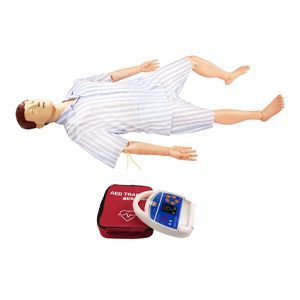
BLS800-1 review: which nine nursing procedures it trains, how the 30:2 CPR and AED modes score, and where a single simulator stops being enough.
...
BLS800-1 Review: What One Multifunctional Nursing Simulator Actually Replaces
A nursing lab with four single-task trainers teaches four procedures and leaves the fifth to the ward. BLS800-1 is built on the opposite logic: one adult simulator carrying nine nursing procedures, CPR with 30:2 feedback and an AED training mode with ten pre-set scenarios. The question a lab manager should ask is not whether it does more, but whether the overlap with existing equipment justifies the bench space. This review works through what the unit does, how it scores, and the cases where it stops being the right purchase.
| Item | Detail |
|---|---|
| Model | BLS800-1 |
| Type | Multifunctional emergency nursing training simulator |
| Nursing functions | Hair and face washing; arm venipuncture, injection and infusion with blood return; deltoid injection; vastus lateralis injection; enema; male and female catheterisation; male and female bladder irrigation; overall care (scrubbing, changing clothes); limb joint movement |
| CPR | 30:2 single or double rescuer, five-cycle sequence, 100–120 compressions/min per the 2020 standard |
| CPR modes | Training operation; universal assessment; customised assessment |
| AED | Training-only AED with 10 pre-set scenario programmes and voice prompts |
| Defibrillation | Training simulation only — no high-voltage shock output |
| Price | Quoted per order |
The nine procedures, grouped by what they test
Circulation access. Arm venipuncture, injection and infusion with simulated blood return, plus deltoid and vastus lateralis intramuscular sites. These are the three injection routes a new nurse is assessed on in the first month, and having them on one torso removes the queue that forms around a single arm trainer.
Elimination and hygiene. Enema, male and female catheterisation, bladder irrigation, and full-body care including washing and changing clothes. Catheterisation is the procedure most often taught by demonstration rather than practice, because a dedicated trainer serves one student at a time.
Airway and resuscitation. 30:2 CPR with cycle counting and a training AED. The AED mode runs ten scripted scenarios with voice prompts, which is enough to rehearse pad placement, "clear" calls and shock sequencing without a live device.
How the CPR and AED feedback works
The unit counts compressions and ventilations, times the cycle in seconds, and supports both universal and customised assessment. Customised assessment matters more than it sounds: an instructor can set the pass threshold to the standard the cohort is being examined against, instead of accepting a fixed pass mark built into the firmware.
One limitation belongs in the purchase decision. The 2020 guidelines specify a compression rate of 100–120 per minute; the listing text prints the range with an extra digit ("100~1200"). Treat that as a typographical error on the page and confirm the actual firmware range with the supplier in writing before you buy for an assessed course.
Where the evidence supports the spend
Simulation in undergraduate nursing is not automatically better than practice on peers; the gain comes from structured scenarios with feedback and debriefing [1]. Debriefing quality, not manikin count, predicts learning [2]. That is the argument for a multifunctional unit: it lets one instructor run a complete scenario — assess, catheterise, deteriorate, resuscitate — instead of stopping the scenario every time a procedure needs different equipment.
On-campus clinical practice built around simulation has been used to prepare students for placement when ward access is limited [3], and a simulator that covers nine procedures is the practical version of that idea.
What BLS800-1 does not do
- No high-voltage defibrillation. The AED is a trainer. It cannot be used on a patient, and it will not accept a real therapy pad stack.
- No automatic scoring printout. Assessment is displayed and timed; if you need printed transcripts for records, that is a different model.
- No neonatal or paediatric mode. This is an adult simulator.
- No airway intubation module on this variant. The sibling BLS800-2 adds tracheal intubation; confirm which variant your course outline requires before ordering.
Buying notes
- Match the variant to the course. BLS800-1 covers nursing plus AED. If your curriculum includes tracheal intubation, specify BLS800-2.
- Ask for the consumables list. Blood powder, catheter sets and enema fluid are not part of the simulator and are consumed every term.
- Confirm the language of voice prompts. Prompt language is fixed at manufacture on most units in this class.
- Plan one unit per six students. Nine procedures on one torso still serialise practice; six is the point where the queue disappears.
- Ask for the assessment printout question explicitly. If records are required, get written confirmation of the output format.
Quotation and consumables. Current pricing for BLS800-1, the BLS800-2 variant and a term's consumables is available from sophia@adahealthy.com.
FAQ
Q1. Which nursing procedures does BLS800-1 include? Hair and face washing, arm venipuncture/injection/infusion with blood return, deltoid and vastus lateralis injection, enema, male and female catheterisation, bladder irrigation, and overall care including scrubbing and changing clothes.
Q2. Does it provide CPR feedback? Yes: 30:2 single or double rescuer, five-cycle sequences, with cycle timing and universal or customised assessment.
Q3. Can the AED deliver a shock? No. It is a training AED with ten scripted scenarios and voice prompts; it does not deliver high-voltage therapy.
Q4. Is intubation included? Not on BLS800-1. The BLS800-2 variant adds tracheal intubation and AED functions — check the variant code before ordering.
Q5. What is the compression rate standard? The listing references the 2020 international standard; the guideline rate is 100–120 compressions per minute. Confirm the firmware range with the supplier.
Q6. What is the price? Quoted per order. Ask for the unit price together with a term's consumables so the comparison is like for like.
References
- Sundler AJ, et al. Undergraduate nursing students' experiences when examining nursing skills in clinical simulation laboratories. Nurse Educ Today. 2015;35:1257–1261. doi:10.1016/j.nedt.2015.04.008
- Kuszajewski ML. Nursing simulation debriefing: useful tools. Nurs Clin North Am. 2021;56:441–448. doi:10.1016/j.cnur.2021.05.003
- Mannino JE, et al. On-campus clinical: preparing prelicensure nursing students for a safe clinical practice. Nurse Educ. 2021;46:180–183. doi:10.1097/NNE.0000000000000864
For a quotation on BLS800-1 or the BLS800-2 intubation variant, write to sophia@adahealthy.com with your cohort size and the procedures you assess.

Marketing Center
Hong Kong, ChinaProduction Base
Shanghai, ChinaProducts
Contact Us
 Address: Hong Kong, China
 Phone:+86 13383897707
 Email:sophia@adahealthy.com
 Mobile:+86-0379-65160607
举报邮箱:sophia@adahealthy.com
举报电话:+86 19937901373
Social Media