

BIX-A1003-2 vs Plain 85 cm vs 180 cm Skeletons: When Coloured Muscle Markings Earn Their Price
Article tag: BIX-A1003-2 85cm skeleton with colored muscle half-life-size skeleton comparison muscle origin an
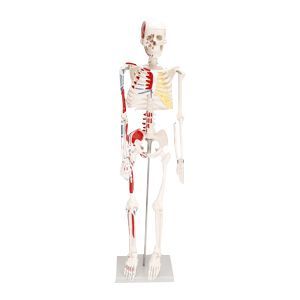
Coloured-muscle 85 cm skeleton vs plain 85 cm vs 180 cm: what BIX-A1003-2 adds to muscle teaching, what it cannot show, and how to choose scale.
...
BIX-A1003-2 vs Plain 85 cm vs 180 cm Skeletons: When Coloured Muscle Markings Earn Their Price
The coloured-muscle version of a half-size skeleton is worth the extra cost only if your syllabus assesses muscle attachments; for joint and bone anatomy alone, a plain 85 cm model does the same job for less. BIX-A1003-2 is an 85 cm human skeleton on a stand with muscle regions painted onto the bones, which puts origin and insertion on the same physical object as the bone they belong to. This comparison sets it against a plain 85 cm skeleton and a 180 cm full-size model so a teaching centre can choose deliberately rather than by habit.
| Item | BIX-A1003-2 | Plain 85 cm skeleton | 180 cm full-size skeleton |
|---|---|---|---|
| Height | 85 cm (half life size) | 85 cm | 180 cm |
| Muscle markings | Painted muscle regions on bone | None | Usually none |
| Main teaching target | Origin, insertion, muscle groups | Bone shape, joint surfaces | Surface landmarks, proportions |
| Bench space | Fits a desktop | Fits a desktop | Needs a dedicated stand or corner |
| Handling in class | One-hand carry | One-hand carry | Two-person lift |
| Best class size | Pairs or small groups | Pairs or small groups | Demonstration to a full room |
| Carton data | Not published by the supplier; quoted per order | Quoted per order | Quoted per order |
What the colour actually adds
Origin and insertion stop being a diagram. On a plain skeleton a student reads attachment sites from an atlas and then guesses which patch of bone the drawing refers to. Colour painted directly on the humerus, scapula or femur removes that translation step: the deltoid tuberosity and the coloured deltoid region are the same object, at the same moment, at the same scale [1].
Muscle groups become visible as groups. Rotator cuff, hamstrings, quadriceps and erector spinae read as continuous regions rather than a list of names. That matters in the first weeks of a course, when students are still building a mental map, and it matters again in clinical anatomy when a patient presents with a pattern of weakness.
It supports verbal examination. An instructor can point at a coloured patch and ask for the muscle, its origin, its insertion and its action without a projector. Physical models used alongside dissection or digital tools produce measurably better anatomy outcomes than either alone, which is the practical argument for keeping a handling model in the room [2].
What the colour costs you
Paint cannot show depth or fibre direction. A coloured region is a two-dimensional footprint on bone; it does not show whether a muscle passes superficial or deep to a neighbour, and it cannot show pennation. Students who learn only from the painted model tend to over-simplify layered regions such as the forearm or the intrinsic back.
Colour competes with bone detail. On a model this size the markings draw the eye. If your assessment is mainly osteology — foramina, processes, articular surfaces — a plain 85 cm skeleton trains attention on the right features and costs less [3].
Half scale distorts measurement. At 85 cm the model is roughly half adult height, so any distance measured on it must be doubled before it means anything clinically. Teach the conversion explicitly, or students will carry a false sense of proportion into surface anatomy.
Choosing between the three options
- Choose BIX-A1003-2 if muscle attachment, muscle groups and joint orientation are examinable and your room has bench space rather than floor space.
- Choose a plain 85 cm skeleton if the course is osteology-first, or if you already use a separate torso model for muscles.
- Choose a 180 cm model when surface landmarking, auscultation points or injection sites are taught, because those skills are proportional to a real body.
- Buy one coloured model per 8–10 students and let pairs rotate; the model is a handling tool, not a poster.
- Ask for the attachment list. Confirm which muscles are painted and whether the legend matches the terminology your syllabus uses.
Documentation and quotation. The current specification, packing data and price for BIX-A1003-2 are available in writing from sophia@adahealthy.com; the supplier does not publish carton data for this item, so request it with your order quantity.
FAQ
Q1. How tall is BIX-A1003-2? 85 cm, a half-life-size skeleton, which is why it fits on a bench and needs a scale conversion when measurements are taught.
Q2. Are the muscles raised or painted? The model is described as a skeleton with coloured muscle markings; the muscle regions are indicated on the bones rather than modelled as separate tissue.
Q3. Does it include a stand? The product image shows the skeleton mounted on a stand with a base, which is how it is supplied.
Q4. What is the carton size and weight? The supplier lists these as not available for this item. Request the packing data with your quotation so freight can be calculated.
Q5. Can it be used for patient education? Yes, for explaining which muscle group is affected, but avoid using it for injection-site or surface-landmark teaching, where full scale matters.
Q6. What is the minimum order quantity? Quoted per order and dependent on destination; ask for both the unit and carton price.
References
- Yammine K, Violato C. The effectiveness of physical models in teaching anatomy: a meta-analysis of comparative studies. Adv Health Sci Educ Theory Pract. 2016;21(4):883–895. doi:10.1007/s10459-015-9644-7
- Koucheki R, Lex JR, Morozova A, et al. Immersive virtual reality and cadaveric bone are equally effective in skeletal anatomy education: a randomized crossover trial. J Surg Educ. 2023;80(7):1028–1038. doi:10.1016/j.jsurg.2023.04.005
- Thomas DB, Hiscox JD, Dixon BJ, Potgieter J. 3D scanning and printing skeletal tissues for anatomy education. J Anat. 2016;229(3):473–481. doi:10.1111/joa.12484
For a quotation on BIX-A1003-2, including the painted-muscle list and the carton data, write to sophia@adahealthy.com with your class size and the muscles you assess.

Marketing Center
Hong Kong, ChinaProduction Base
Shanghai, ChinaProducts
Contact Us
 Address: Hong Kong, China
 Phone:+86 13383897707
 Email:sophia@adahealthy.com
 Mobile:+86-0379-65160607
举报邮箱:sophia@adahealthy.com
举报电话:+86 19937901373
Social Media