

BIX/G105-1 Review: What a Bleeding Thigh Trainer Actually Tests
Article tag: control bleeding thigh model BIX/G105-1 review femoral hemorrhage training Stop the Bleed trainer
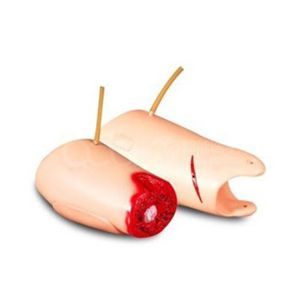
A haemorrhage trainer is only worth its bench space if it forces a trainee to make decisions under pressure. The BIX/G105-1 does that in a narrow, useful lane: it gives you an amputated thigh and a wounded thigh, both able to bleed under arterial pressure, so students practise packing, bandaging and tourniquet placement on the same anatomy they will meet in a trauma bay. It is not a full casualty simulator, and buyers should know that before comparing quotes.
Quick facts
| Item | Detail |
|---|---|
| Model | BIX/G105-1 |
| Type | Controlled bleeding thigh model |
| Trauma modules | Two: thigh amputation and thigh wound |
| Bleeding system | Fillable with simulated blood; reproduces arterial pressure |
| Procedures | Bleeding control, wound packing, bandaging, amputated-limb dressing, tourniquet practice, IM injection into vastus lateralis |
| Package size | 63.5 × 23 × 19.5 cm |
| Gross weight | 4 kg |
| Quantity per carton | 1 |
| Price | Quoted per order |
| Certification | ISO documentation on request |
What you can actually drill
The model supports three distinct stations, which is more than most single-module trainers offer.
Station 1 — direct pressure and packing. The wounded thigh module accepts simulated blood and holds pressure, so a trainee can practise opening a dressing, applying direct pressure and packing without the instructor narrating every step.
Station 2 — tourniquet on an amputation. The amputated thigh gives a clear proximal landing zone. Trainees can place a commercial tourniquet, tighten until bleeding stops and record the time. This is the skill that transfers most directly to prehospital practice: tourniquet use in major limb trauma has been associated with markedly better survival in military series [1], and the American College of Surgeons Committee on Trauma guideline recommends early tourniquet application for life-threatening extremity bleeding [2].
Station 3 — IM injection. The vastus lateralis site on the thigh allows intramuscular injection practice. That is an unusual add-on for a haemorrhage trainer, and it makes the model useful in nursing programmes that teach emergency medication alongside bleeding control.
The pressure system is the deciding feature
A static wound model teaches dressing technique; a pressurised model teaches whether the dressing actually controls the bleed. The G105-1 lets you fill the reservoir with simulated blood and reproduce arterial pressure, so the trainee sees flow stop — or not — in response to what they do.
That feedback matters because Stop the Bleed-style courses show measurable gains in skills, knowledge and confidence after hands-on training [3], but the gain depends on practising the decision, not just the hand motion. A model that keeps bleeding until the tourniquet is tight enough gives the trainee a real endpoint.
Practical notes from a lab perspective: use a drip tray, keep a spare reservoir, and assign one person to refill and clean between rotations. Simulated blood is the main consumable, and a 4 kg model is light enough to move between rooms but heavy enough to stay put during a two-handed tourniquet application.
What holds up in review
- Two modules in one unit. Amputation and laceration cover the two most common teaching scenarios.
- Palpable anatomy. The thigh shape gives a believable landmark for tourniquet placement high and tight.
- Portable. At 4 kg and 63.5 cm long, it fits a carry case and a standard skills-lab shelf.
- No electronics. Nothing to charge, calibrate or update; the failure modes are a torn reservoir or a worn skin, both replaceable.
Where the model stops
- No pulse or vital signs. The trainer does not simulate a falling blood pressure or a palpable distal pulse.
- No sensing or scoring. Control is judged by the instructor's eye, not by sensors.
- Single limb. Junctional bleeding, pelvic bleeding and multi-site casualty scenarios need other models.
- Skin wear. Repeated needle and tourniquet work will mark the surface; ask for a replacement skin in the quotation.
For a Stop the Bleed course or a nursing lab, those limits are acceptable. For an ALS or tactical casualty course, this model is one station, not the course.
Buying checklist
- Count stations, not students. One unit per four to six trainees keeps hands-on time above half of a 60-minute rotation.
- Budget the consumables. Simulated blood, dressings and tourniquets are consumed every class; ask for a per-100-trainee estimate.
- Order a spare skin and reservoir. These are the parts that fail first.
- Check the carton. 63.5 × 23 × 19.5 cm and 4 kg are easy to store, but confirm the export carton if you ship between campuses.
- Ask for the cleaning procedure in writing. Simulated blood must be flushed from the tubing after each session.
FAQ
Q1. Does the model bleed on its own? It holds simulated blood and reproduces arterial pressure after filling. The flow is controlled by the model's reservoir and the trainee's intervention, not by a pump.
Q2. Can it be used for tourniquet training? Yes. The amputated thigh module provides a proximal site for commercial tourniquet application and timing.
Q3. What is the price and minimum order? Price is quoted per order. Email sophia@adahealthy.com with quantity, destination and course type for a current quotation.
Q4. What consumables do we need? Simulated blood, gauze and dressings, tourniquets and cleaning fluid. Ask for a consumable estimate sized to your annual intake.
Q5. How long does delivery take? Lead time depends on quantity and destination. Request it in writing with the quotation and add customs clearance time for your country.
Q6. Is there a warranty and are spare parts available? Warranty terms and spare-part availability should be confirmed in the quotation. The replaceable skin and reservoir are the parts to specify.
References
- Kragh JF Jr, Walters TJ, Baer DG, et al. Survival with emergency tourniquet use to stop bleeding in major limb trauma. Ann Surg. 2009;249(1):1-7. doi:10.1097/SLA.0b013e31818842ba
- Bulger EM, Snyder D, Schoelles K, et al. An evidence-based prehospital guideline for external hemorrhage control: American College of Surgeons Committee on Trauma. Prehosp Emerg Care. 2014;18(2):163-173. doi:10.3109/10903127.2014.896962
- Schroll R, Smith A, McSwain NE, et al. Stop the Bleed training: rescuer skills, knowledge, and attitudes of hemorrhage control techniques. J Surg Res. 2020;245:636-642. doi:10.1016/j.jss.2019.08.011
Contact
For a quotation, the consumable list or a demonstration video: sophia@adahealthy.com. Production follows ISO 45001 management practice; CE documentation is available for EU procurement.

Marketing Center
Hong Kong, ChinaProduction Base
Shanghai, ChinaProducts
Contact Us
 Address: Hong Kong, China
 Phone:+86 13383897707
 Email:sophia@adahealthy.com
 Mobile:+86-0379-65160607
举报邮箱:sophia@adahealthy.com
举报电话:+86 19937901373
Social Media