

ADA-404 Review: What a Basic Half-Body CPR Model Actually Fixes
Article tag: basic CPR training model ADA-404 review half body CPR manikin first aid training equipment
ADA-404 Review: What a Basic Half-Body CPR Model Actually Fixes

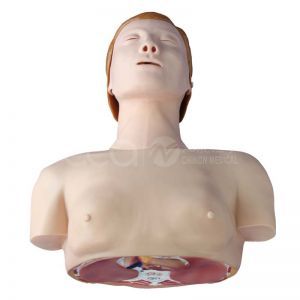
A basic half-body model is the cheapest way to put a chest under every pair of hands in a first aid course, and that is exactly the job the ADA-404 does. It is an anatomical half torso built for compression and ventilation practice — no screen, no scoring, no batteries. Whether that is a limitation or an advantage depends entirely on what your course is assessing.
Quick facts
| Item | Detail |
|---|---|
| Model | ADA-404 |
| Category | Emergency models / CPR |
| Build | Anatomical half body, adult proportions |
| Intended use | First aid teaching, hygiene education, demonstration and skills practice |
| Feedback | None — no electronic compression or ventilation scoring |
| Consumables | Disposable face shields or lungs, disinfectant wipes |
| Certification | ISO 9001 / 14001 / 45001 and CE documentation on request |
| Price | Quoted per order |
What it does well
Volume practice. The strongest argument for a basic model is arithmetic. If a cohort of 24 trainees shares two feedback manikins, each trainee gets a few minutes of hands-on time; with eight basic models, each gets three to four times as many compression cycles in the same session. Since skill acquisition depends on repeated performance with feedback rather than on exposure alone [2], the cheapest way to raise repetition is often more bodies, not more electronics.
Hygiene routines. Ventilation practice forces the routine that actually prevents cross-infection: face shield on, seal checked, one-way valve inspected, wipe-down after each trainee. A model without electronics survives disinfectant that would destroy a sensor panel.
Demonstration and lay audiences. For school programmes, workplace first aid and community courses, a half body is enough to show hand position, arm alignment and recoil without a power supply or a laptop.
What it cannot measure
This is where buyers are usually disappointed, so it belongs in the first paragraph of the quotation request, not the last:
- No depth or rate feedback. Compression quality is judged by the instructor's eye and hand.
- No ventilation volume data. Adequate chest rise is a visual judgement only.
- No recording or scoring. There is no printable report for certification.
- No rhythm or AED interface. Cardiac scenarios need separate equipment.
Guidelines are explicit that compression depth and rate are the variables that matter most for outcome [1]. A model that cannot report them is a practice tool, not an assessment tool.
The honest comparison: basic vs feedback
| Question | Basic half body (ADA-404) | Feedback manikin |
|---|---|---|
| Cost per trainee station | Lowest | Two to five times higher |
| Compression depth and rate data | No | Yes, per compression |
| Certification evidence | Instructor judgement | Printable report |
| Maintenance | Wipe-down only | Sensors, batteries, software |
| Best cohort size | Large, introductory | Small, assessed |
The practical rule most training centres converge on: buy feedback units for the assessed station, buy basic units for the practice floor. A 1:4 ratio of feedback to basic models covers both needs at a fraction of an all-feedback budget.
That ratio follows the education evidence rather than the equipment catalogue. The American Heart Association's education science statement concludes that short, frequent practice episodes with corrective feedback outperform single long sessions, and that the limiting factor in most courses is hands-on time per trainee, not device sophistication [3]. Ten minutes of compressions on a basic model, repeated across four weeks, beats one twenty-minute block on a feedback unit.
A 45-minute lay course built on it
- 8 minutes — demonstration. Hand position, arm lock, 5–6 cm depth, 100–120 per minute.
- 12 minutes — practice in pairs. One compresses, one counts aloud and checks recoil.
- 10 minutes — ventilation. Face shield, seal, two breaths, back to compressions.
- 10 minutes — scenario. Collapse, call for help, AED arrival, handover.
- 5 minutes — debrief. One correction per trainee, written on the attendance sheet.
FAQ
Q1. Does the ADA-404 give any feedback?
No. It has no electronic scoring. Compression depth, rate and chest rise are judged by the instructor.
Q2. Can it be used for certification?
It supports practice, not assessment. If your certificate requires recorded compression data, use a feedback manikin for the assessed station.
Q3. Is it adult size only?
The model is built on adult anatomy. Paediatric and infant training require separate models.
Q4. What consumables does it need?
Disposable face shields or lungs and disinfectant wipes. Ask for a per-100-trainee estimate with your quotation.
Q5. What is the price and minimum order?
MOQ is flexible and quoted per order. Email with the quantity and destination for the current price list.
Q6. How do we request a sample or a class-size quotation?
Email sophia@adahealthy.com with quantity, city and course type; you will receive the price list, carton dimensions and lead time.
References
- Olasveengen TM, Mancini ME, Perkins GD, et al. Adult Basic Life Support: 2020 International Consensus on Cardiopulmonary Resuscitation and Emergency Cardiovascular Care Science With Treatment Recommendations. Circulation. 2020;142(16_suppl_1):S41-S91. doi:10.1161/CIR.0000000000000892
- Cook DA, Hatala R, Brydges R, et al. Technology-enhanced simulation for health professions education: a systematic review and meta-analysis. JAMA. 2011;306(9):978-988. doi:10.1001/jama.2011.1234
- Bhanji F, Donoghue AJ, Wolff MS, et al. Part 14: Education — 2015 American Heart Association guidelines update for CPR and emergency cardiovascular care. Circulation. 2015;132(18 Suppl 2):S561-S573. doi:10.1161/CIR.0000000000000268
Contact
For the specification sheet, consumable pricing and a cohort-size quotation: sophia@adahealthy.com. Production follows ISO 45001 management practice; CE documentation is available for EU procurement.

Marketing Center
Hong Kong, ChinaProduction Base
Shanghai, ChinaProducts
Contact Us
 Address: Hong Kong, China
 Phone:+86 13383897707
 Email:sophia@adahealthy.com
 Mobile:+86-0379-65160607
举报邮箱:sophia@adahealthy.com
举报电话:+86 19937901373
Social Media