

BIX-Z/XD1 ECG Simulator: Teaching 12-Lead Interpretation
Article tag: BIX-Z/XD1 ECG simulator 12-lead ECG training simulator electrocardiogram teaching model ECG rhythm s
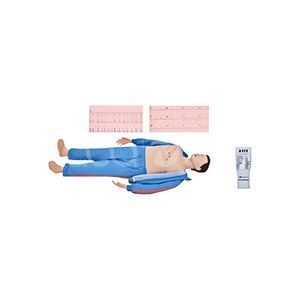
200 stored rhythms, standard 12-lead electrode placement and a presettable rate — students record a real tracing instead of reading a printed strip.
...
BIX-Z/XD1 Guide: Teaching 12-Lead ECG Interpretation on a Patient Who Never Complains
Short answer: The BIX-Z/XD1 is a microcomputer-controlled ECG simulator built into a lifelike simulated patient. It stores 200 kinds of normal and abnormal ECG signals, each identified by an analogue and a digital code. The chest and limbs carry standard twelve-lead electrode placement identical to that of a real person, so the unit can be wired to a clinical ECG machine or monitor — the machine then draws a genuine tracing from the code the teacher dials in. Heart rate can be preset and changed while the trace is running.
Key takeaways
- 200 stored ECG signals — normal and abnormal — selected by a code entered on the panel
- Standard 12-lead electrode placement on chest and limbs, matching real patients
- Connects to a clinical ECG machine or monitor, so students read a live recording
- Heart rate is presettable and adjustable during output
- Advanced art-makeup techniques are used to make the simulated patient look lifelike
- Teaching and assessment can run on the same machine, on the same day
What the simulator actually does
| Feature | Specification on the product page |
|---|---|
| Control | Microcomputer control of the signal library |
| Signal library | 200 normal and abnormal ECG signals |
| Coding | Each signal carries an analogue and a digital code |
| Electrodes | Standard twelve-lead placement on chest and limbs, as on a real person |
| Output | Can be connected to a clinical ECG machine or ECG monitor |
| Rate | Heart rate presettable and changeable during output |
| Body | Simulated person finished with advanced art-makeup techniques |
Why "reading a strip" is not the same as "recording a strip"
Traditional teaching, as the product page puts it, can only obtain electrocardiograms from the human body for students to read and analyse; abnormal patterns are studied from existing graphic data. That gap matters, because ECG reading is a pattern-recognition skill that has to be practised against a signal the learner did not choose.
The clinical stakes are high. Cardiovascular disease remains the leading cause of death worldwide, and the 2019 Global Burden of Disease update attributes a large and growing share of global mortality to ischaemic heart disease and stroke [1]. In the United States, the American Heart Association's 2024 statistical update continues to report cardiovascular disease as the underlying cause of a substantial fraction of all deaths [2]. Trainees who cannot reliably separate a normal tracing from a dangerous one are working without their most basic bedside instrument.
Simulation closes part of that gap when it is used deliberately. The meta-analytic comparison by McGaghie and colleagues found that simulation-based medical education with deliberate practice produced better results than traditional clinical education for skill-acquisition goals [3], and a later review of simulation-based mastery learning documents translation of that practice into measurable downstream outcomes [4]. A rhythm library of 200 signals is only useful if it is used as a practice set, not a slideshow.
Running an ECG session with the XD1
- Start normal, then deviate. Begin with a normal tracing so the class fixes a reference, then introduce one abnormality at a time.
- Make them wire it. Students place the 12 leads themselves. Wrong limb-lead placement is one of the most common real-world errors and is invisible if the teacher does the wiring.
- Dial the code, don't announce it. Enter the code on the panel yourself; the class must state rate, rhythm, axis problems and morphology before any answer is given.
- Change rate mid-trace. Because the heart rate can be altered during output, you can demonstrate rate-dependent changes without resetting the station.
- Score it. Wire the unit to a monitor and run an OSCE-style station: five tracings, a fixed time limit, a marking sheet per pattern.
What to check before you order
- Machine compatibility. Confirm the connector set against the ECG machine or monitor you already own before purchase.
- Signal list. Ask the sales team for the current list of the 200 stored signals and check it against your curriculum.
- Language and labelling. Confirm the language of any panel text and documentation if your programme is taught in English.
- Price. The page does not publish a price; the unit is quoted on request and depends on volume.
FAQ
Q1. What is the BIX-Z/XD1?
It is a microcomputer-controlled ECG simulator built into a lifelike simulated patient, used to teach and assess 12-lead electrocardiogram interpretation.
Q2. How many ECG signals does it store?
Two hundred normal and abnormal ECG signals, each represented by an analogue and a digital code and selected by entering the code on the panel.
Q3. Can it work with our existing ECG machine?
Yes — the chest and limbs carry standard twelve-lead electrode placement exactly as on a real person, so the unit can be connected to a clinical ECG machine or ECG monitor.
Q4. Can the heart rate be changed during a demonstration?
Yes. The simulated heart rate can be preset and also changed while the waveform is being output.
Q5. Is it only for teaching, or also for exams?
Both. During teaching practice or assessment the operator enters the code for the required ECG, and the machine or monitor draws the characteristic waveform for the student to interpret.
Q6. How do I get pricing or a demonstration?
Email sophia@adahealthy.com with the model (BIX-Z/XD1), the quantity you are considering and your destination port; our export team will reply with pricing, lead time and configuration.
Request a quotation
Email sophia@adahealthy.com for the BIX-Z/XD1 price list and shipping details. If your programme also covers resuscitation and clinical-examination skills, the same catalogue includes first-aid training simulators and cardiopulmonary examination systems, so ECG practice, auscultation and CPR can be specified in a single purchase.
References
- Global Burden of Cardiovascular Diseases and Risk Factors, 1990–2019: Update From the GBD 2019 Study. Journal of the American College of Cardiology. 2020
- 2024 Heart Disease and Stroke Statistics: A Report of US and Global Data From the American Heart Association. Circulation. 2024
- Does simulation-based medical education with deliberate practice yield better results than traditional clinical education? A meta-analytic comparative review of the evidence. Academic Medicine. 2011
- A critical review of simulation-based mastery learning with translational outcomes. Medical Education. 2014

Marketing Center
Hong Kong, ChinaProduction Base
Shanghai, ChinaProducts
Contact Us
 Address: Hong Kong, China
 Phone:+86 13383897707
 Email:sophia@adahealthy.com
 Mobile:+86-0379-65160607
举报邮箱:sophia@adahealthy.com
举报电话:+86 19937901373
Social Media